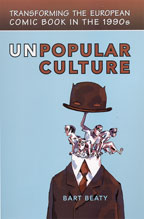
While this CFP doesn't explicitly mention comics, there certainly seems to be room for work on the form here...
Call for Papers
Texts, Forms and Readings in Europe
(18th – 21st Centuries)
22-24 May 2013 - Université du Maine, Le Mans, France
(SHARP International Focussed conference)
This conference will question the relevance of the notion of a common European reader with regard to the evolution of reading practices from the so-called reading revolution in the 18th century until the current digital revolution. Europe is known as the birthplace of books, and it remains a major seat of book publishing and translating. Since an early stage its strongly established book culture has implied the durable circulation of books. This tradition has contributed to cultural exchanges and to the creation of reading communities across national borders. A relationship to the book and to reading, as well as their promotion and enhancement, seems to be a common value and a significant component of European identity. However, book policies and reading practices in Europe have varied from one region to another throughout history. Such idiosyncrasies – whether regional, national, social, economic, cultural or legal – make European identity recognizable even though nowadays globalization and the digital revolution tend to reduce those specificities.
Guglielmo Cavallo and Roger Chartier’s
A History of Reading in the West (Polity Press, 1999) has taught us that reading is not an abstract action: it realizes itself through practices, situations, and readers, who “are never faced with an abstract, ideal text detached from everything material: they manipulate objects; they listen to words whose modalities govern the way they read or listen, but in the process also govern ways of comprehending the text.” Taking into account the strong link between texts, forms and readings as well as the fact that reading has not remained immutable, this interdisciplinary conference will study the elements of continuity and disruption that are characteristic of the uses of texts and of reading practices in 18th-21st-century Europe.
The conference welcomes proposals on the following topics:
- The relationship between reading practices and the evolution of printed material forms.
- The effect of new formats (audio, digital etc.) on reading theories and practices.
- The relationship between new social issues, new groups of readers and new kinds of reading practices.
- The correlation between cultural policies, educational policies, national identities and reading.
- The existence, resistance or erosion of potential European reading models.
- New and former sites of communal or solitary reading.
- Access to science and knowledge through books and reading.
- The role and issues of image and non-book printed material in informal reading practices.
- The representation of reading in the arts (film, literature, painting, photography).
We have planned a pre-workshop for early career researchers (including PhD students and post-docs) interested in all aspects of children’s, teenagers’ and young adults’ reading practices. This pre-workshop will consist of a poster session with a moderator.
Recommendations:
- Proposals should adhere to the aforementioned spatiotemporal frame and may consist of a case study or of a broader theoretical approach.
- Papers with a comparative approach are particularly welcome.
- The languages of the conference are English and French.
- The proposals (a 500-word abstract in French or in English, specifying the theoretical and methodological context, sources, etc.) will be reviewed by the program committee.
- Papers will be considered for further publication.
Proposals for 20-minutes presentations should be sent to the program committee before
December 7th, 2012: Prof. Brigitte Ouvry-Vial
Textes-Formes-Lectures2013@univ-lemans.fr Proposals of posters (A1) for the pre-workshop should also be sent to Corinna Norrick-Rühl
norrick@uni-mainz.deSchedule:
- Deadline for submission of proposals: 7th December 2012
- Notification of acceptance: 15th January 2013
- Deadline for confirmation of participation: 1st February 2013Practical details (registration fees etc.) will be sent with the notification of acceptance
Guest speakers:
Opening lecture by Prof. Roger Chartier (Collège de France)
Closing lecture by Prof. Bernard Lahire (Ecole Normale Supérieure Lettres et Sciences Humaines)
Program committee: Laurent Bazin (University Versailles - Saint-Quentin-en-Yvelines), Jean-François Botrel(University Rennes II), Lodovica Braida (University Milano), Hans-Jurgen Lüsebrink (University Sarreland), BrigitteOuvry-Vial (University Maine), Nathalie Richard (University Maine), Jürgen Ritte (University Paris III – Sorbonne Nouvelle)
Institutional partners: SHARP; Université du Maine (Le Mans) ; Lab « Langues, Littératures, Linguistique » Universities of Angers and Maine; Dipartimento di Studi storici from Università degli Studi Milano and APICE; Ville du Mans ; Carré Plantagenêt, Musée d’Art et d’Histoire (le Mans).
Location: Le Mans is located 50 mn from Paris by train. In the middle of Region Pays-de-la-Loire, it is famous for its white wines, its
Rillettes special pâté, and aside from the formula One race « 24 heures du Mans », it features several theater companies and a stunning historical district, Cité Plantagenêt (the film
Cyrano de Bergerac was shot there), where conference participants will enjoy crawling.
Thank you for your attention and proposals,
Yours,
Brigitte Ouvry-Vial
Professeur des Universités
Université du Maine (Le Mans, France)
Labels: academic, book history, cfps, conferences, europe, France, reading, SHARP-L