Tuesday, November 19, 2013

Historic Virtuoso Cartoonists Essay (OSU Festival of Cartoon Art 2001)

I attended my first Ohio State University Festival of Cartoon Art in 1998, and there I was lucky enough to get to met and talk to Lucy Shelton Caswell, curator of the Cartoon Research Library (now the magnificent Billy Ireland Cartoon Library and Museum). I kept in touch with Lucy and was honored when she invited me (along with 30-some other writers, all of whom were better known than I) to contribute a short essay to the 2001 catalog, Historic Virtuoso Cartoonists

I'm in the middle of writing my impressions of this past weekend's Festival of Cartoon Art, and in the process I thought I'd post my 2001 essay. Here it is, as originally included on pages 31 and 33 of the catalog.

A virtuoso cartoonist creates comics which combine utterly original graphic techniques with a purely personal and artistic point of view. Much like a virtuoso violinist, a virtuoso cartoonist shapes appealing artistic experiences for the audience in a way which no one else can. Defining these qualities becomes problematic, beginning even with the question of whether to include the work of cartoonists who work in collaboration. Do we focus only on those cartoonists who "did it all?" (Of course, this distinction ignores the fact that many, if not most, cartoonists use assistants of one sort or another.)

To be sure, in some circles the auteur theory often holds quite strongly. And I would agree that, on average, it is most common that the most satisfying comic art arises from single creators; the harmonious blend of words and pictures (in those comics which use words) perhaps comes most naturally when a single intelligence judges how the two elements best combine, where neither element dominates and both are intrinsically necessary. For example, the classic comic strips which rank most highly in popularity polls are invariably those created by a single artist. The quality of the line, the turn of phrase, and the world view are themselves, in these cases, perfectly in balance.

Recall, though, that virtuoso violinists are not expected to write the music they perform - their acclaim stems from their technique and the interpretive sensibilities they convey. So too, I think, should we value cartoonists for the skills they bring to interpreting a story, whether their own or someone else's. The comics art form, after all, was nurtured (and still primarily thrives) in commercial environments - settings which, if they are not antithetical to "pure art for art's sake," are at least more at home in collaborative ventures.

But cartooning is about storytelling, shaping a narrative idea through the juxtaposition of visual elements. The script for this narrative may be written by the cartoonist or by someone else, but ultimately it is the cartoonist's job to provide its shape, a map for the reader to follow. The best source text will still translate into mediocre comics unless the cartoonist applies a strong storytelling - story-shaping - dimension to the work. Collaborative cartoonists tell the story just as much as the "writer" does, for a comic's words ultimately depend upon the images and their arrangement for their context. The best cartoonists can take any source material and, through their technique, give it shape in a way no one else would consider.

We would do well also to recall that "virtuoso" can also mean an experimenter or investigator; and certainly, many of the most highly regarded cartoonists are well-known for their own experiments with the comics form. What distinguishes these cartoonists is that their innovations, their explorations, and their re-imaginings all serve to facilitate their storytelling, not simply as ends in themselves. The work such cartoonists produce must ultimately communicate a felt experience to be appreciated for more than simply novelty value. A virtuoso experimenter may begin with Simple tricks, but the tricks themselves soon become but an expanded toolbox from which the cartoonist can draw a wider range of techniques than are available to the non-experimenter. The virtuoso uses such experiments to create humor and art which touch our emotions as well as impress our understanding. Not every experimenter becomes a virtuoso, but every virtuoso was, at one point or another, an experimenter.

Labels: , , , ,


Tuesday, October 08, 2013

An Ape of One's Own (for Phil Nutman)

This is for you, Phil.

Right now, I should be preparing my presentation on opportunities for female cartoonists in children's literature, which I was invited to give at the University of Connecticut next week. But before I can do that, I want - I need - to post an old review-essay of mine, from July 2006. It has nothing to do with comics, although it does talk a bit about animation. But if it weren't for the essay below, I'm not certain that I would be speaking at UConn next week.

Several years ago, I was going through a very rough period, and one of the side effects was that I was no longer writing. Oh, I was trying to write; but nothing would ever gel, not my words, not my thoughts. I received plenty of invitations to write. But my projects were started, sweated over, and abandoned. I had a lot of supportive people in my life, but there were hurdles over which I simply couldn't make it.

Several years before that, I and my then-wife Kate had met Phil Nutman and his then-wife Anya at Necon, and somehow we all hit it off. He was a gregarious British author (Wet Work) and journalist (Fangoria), and he was getting into film; I was a wallflower American academic. But still. Soon every year we were a foursome in the Necon min-golf tournament, and I would spend many late nights with Phil in wide-ranging conversations. He was whip-smart, razor-funny, and hyper-energetic.

In the early summer of 2006, deep into my depression, Phil contacted me about a new online magazine he was starting, Up Against the Wall: The Magazine that Takes No Prisoners. (Phil never did things in half-measures.) He asked me to review something near and dear to both our hearts: The recent 14-disc PLANET OF THE APES ULTIMATE DVD COLLECTION. We had bonded in part over our love of the Apes films, so naturally (for him) he thought of me to write a review for the first issue of his new magazine. I tried to beg off of it; I desperately wanted to write the piece, of course, but I knew that I couldn't do it. I had disappointed too many editors in the past few years, and I wasn't about to do that to Phil, too.

Phil would not let me get away with that.

I don't remember exactly which ploy of Phil's was finally the one to get me to cry "uncle" and swear that I would try, although I do remember more than a couple of emails and phone calls. Undoubtedly there was begging, there was flattery, there were promises about lord knows what now. But Phil made one thing perfectly clear: He believed in me.

This was something that all of Phil's friends knew and could never doubt: Phil believed in them. And here he was, believing in me! Again, other people did, too - I was not alone or abandoned. But Phil's belief was somehow extra-special to me at that time.

He asked for 1500 words. I began typing - hesitantly, at first, but gradually with more gusto. I was used to writing for academia, which demanded a voice which, while not exactly  cold, was nevertheless analytic and impersonal. Even my writing for The Comics Journal, a non-academic publication, had been analytic - I rarely cut loose with my own voice (whatever that was). But Phil wanted me, my passions and not just my brain. He wanted the sense of fun that permeated our conversations to come across through my writing. This was A LOT to ask of me, especially then.

But perhaps that was also the BEST time for him to have asked. He wanted 1500 words; I stopped at nearly three times that number. The writing was hard; it was excruciating; and the result was rough. But it was also fun, by god. It's peppered with jokes (or at least attempts at same) and a bit of foul language. I willed myself to be goofy in print, for once, because Phil expected that.

This review became the only substantial thing I had written in a few years. And Phil loved it, and he wanted to run the whole bloody thing. Anya copy-edited and formatted it with care, and it appeared in the very first issue of Up Against the Wall.

In a fairy tale, this would be the turning point in my life, and I would have started writing again in volume, and better than I ever had before. But as Phil himself knew well, life is no fairy tale. Writing this piece felt great, the sense of accomplishment felt wonderful; but writing was still damned difficult. And it continues to be for me, to this day. I still struggle mightily, but occasionally now there are accomplishments. However, until Phil coaxed the following review out of me, I was pretty well convinced that all of my accomplishments lay behind me. I could never thank him enough for getting me over an ENORMOUS psychological hill.

And now I never will. Phil passed away last night, at the age of 50.

His death was stupid - all deaths are, of course, but his was doubly so, because it should have been preventable. The cliche is to say that Phil was a great guy, but that he was also haunted by demons. And Phil's demons apparently arrived in bottles. That's a side of his that I never really experienced - we hadn't seen each other in a few years, and our correspondence had become spotty and... strange. These often weren't the words of the Phil I recalled so fondly. The Phil I recall is the one who cast me in a 24-hour guerrilla film, who took me shopping before cooking dinner and enthused over fresh vegetables, who got me to unlock my word-hoard when no one and nothing else could. That's the Philip Nutman I mourn tonight.

[UATW folded a couple of years after it began, and the website has long since disappeared. I rescued this essay from Archive.org, cleaning up the dead links. I started to make a few revisions, but then decided to stop. Warts and all for you, Phil.]

An Ape of One’s Own


PLANET OF THE APES: THE ULTIMATE DVD COLLECTION
Review By Gene Kannenberg, Jr.
originally published in Up Against the Wall no. 1, July/August 2006.

I was a child of the Apes.

Growing up in the late 60s / early 70s, I was just the right age to utterly buy into the hype when the PLANET OF THE APES media saturation campaigns were in full swing. I clearly remember my brother and I sitting too close to the TV every Friday night for a month at a time, all the better to absorb Channel 18's twice-yearly (at least) POTA marathons. I was enthralled by the time-travel paradoxes, the evolutionary questions, the philosophical –

Who’m I kidding? I was eight years old. I was in it for the freaking apes, man.
I could not get enough. I've lost count of how many times I saw PLANET; I found BENEATH a bit creepy, especially when the mutants "revealed their inmost selves"; ESCAPE contributed greatly to my (well-deserved) mistrust of authority; CONQUEST could claim both a fightin'-mad Roddy McDowell and another star turn by Ricardo "I love chimpanzees best of all other apes" Montalban; and BATTLE… Well, even when you’re nine years old, you can usually tell shit from Shinola. I caught most of the live-action TV series in its initial run, but I only ever managed to see a few scattered episodes of the Saturday-morning cartoon series thanks to CCD (“Confraternity of Christian Doctrine,” Catholic church’s “Sunday School on Saturday”). And I had my Mego-manufactured Cornelius action figure (doll) – not Galen, dammit; Cornelius – which, in arranged cage matches, would kick the shit out of both my Mego Batman and my Mego Mr. Spock.

So I was pretty excited to learn about PLANET OF THE APES: THE ULTIMATE DVD COLLECTION. For some unfathomable reason I’d skipped buying the earlier DVD box set, although I did manage to acquire – and enjoy the heck out of – the "35th Anniversary Widescreen Edition" double-disc set of the original PLANET. I’d also skipped on getting the TV series collection, partly because I’m cheap, but mostly because I hadn’t remembered a whole lot about it; and what I did remember wasn't all that great. (Except for watching a French-dubbed episode with my wife in Belgium about a decade ago – which was actually pretty cool; finally, the apes were speaking the language of their creator, Pierre Boulle.)

But the ULTIMATE DVD COLLECTION offers just about every APES-related film and TV appearance all in one fell, easy-to-collect swoop. In one small disc folder (the size of five CD jewel cases in a stack) you get all five original films (including the two-disc incarnation of PLANET); the complete live-action POTA television series (including one never-aired episode); and the heretofore-only-available-by-bootleg Saturday morning cartoon series RETURN TO THE PLANET OF THE APES. Oh yeah, you also get the two-disc version of Tim Burton’s stylized but brain-dead (don’t forget "soul-less"!) 2001 "re-imagining."

Best of all, the brick-o'-discs fits snugly into the back of your very own, nearly life-size bust of Caesar! But more on that anon.

Space and sanity preclude me from discussing every movie and every episode in any real detail, but I do want to offer some scattershot observations:

PLANET OF THE APES (1968): The one. The only. Heston of the Apes*. Only Chuck would be cocky enough to smoke a cigar in an oxygen-rich space capsule. Yes, his over-acting at times nearly out-Shatners Shatner – but you can forgive it, because this character’s trapped in a maaaadhouse! And he's alone. Whether you want to or not, you feel for this man; sure, he's a misanthrope, but a misanthrope on a quest for something better than the society he’s willingly left behind. Finding the Statue of Liberty at movie's end only proves to him how right he really was about that society all along – especially poignant after his heartfelt rant to Zaius that "Man was here first – and he was better than you!" And the only thing more effective than Jerry Goldsmith's staccato score in setting the film's disquieting tone is his decision to use no music at all in that final shot. Taylor's world has collapsed, but the ocean pays it no mind…

BENEATH THE PLANET OF THE APES (1970): General Ursus speaks with a religious zeal echoing that of the current [2006] President of the United States ("It is our holy duty to invade!"). But then, so do the mutant underworlders ("The Bomb is a holy weapon of peace" – "Traumatic illusion is a weapon of peace"). To be honest, watching the movie as an adult was more disturbing than when I was a child; those "mutants" were just wearing make-up, but ideas and ideologies aren’t so easily dismissed as you lie awake at night.
Other fun facts:
  • We get to enjoy not one but two future BARNEY MILLER cast members! (Gregory Sierra as “Verger” and James Gregory’s star-turn as "Ursus").
  • Don Pedro Colley must be ever-so-proud that he will be forever remembered by his character's official name as given in the credits: "Negro.”
  • My wife noticed that the hieroglyphic markings on one ape banner look suspiciously like they read "Jeb" (see "religious zeal," above).

ESCAPE FROM THE PLANET OF THE APES (1971): An ingenious way to further the franchise and disguise shrinking budgets: "We'll only use three apes and kill one of them quickly. Think of the money we'll save on make-up!" "But sir, the script calls for Dr. Milo to be killed by a gorilla – doesn't that mean four apes?” "Don't bother me with details – just rent the worst damned gorilla suit you can find!" A pity that the scene where Cornelius learns all the lyrics to "I'm My Own Great-Great-Great-Great-Great-Great-Grandpa" never made it out of the script’s third draft.


The 1973 novel adaptation, by John Jakes
CONQUEST OF THE PLANET OF THE APES (1972): This one does get dark, indeed – apart from Caesar's candy-coated, re-written and re-voiced speech at film's end. While it sort of allows us to see in Caesar a certain predisposition to nonviolence like his parents displayed, it still feels utterly tacked-on after his more-than-justifiable rage. But how, exactly, does one smallish revolt in one city allow all these primitive apes to gain intelligence and overtake the rest of the world? Wouldn't the US Army easily be able to wipe out this pocket of gorilla – guerilla – insurgents? Oh, there's a fifth movie, you say? That'll explain it all, yeah…


BATTLE FOR THE PLANET OF THE APES (1973): Nope.
OK, the film deserves a bit more than that, particularly since now we finally get the extended edition of this film – it's about 10 minutes longer than the theatrical cut. It appears that most of the extra material centers around the bomb sub-plot: The under-dwellers consider using the bomb to solve their ape-infestation problem, but cooler heads ultimately prevail. It's a nice nod to continuity with BENEATH to include this material, even if the film elements are a bit rough (especially the sound in some places). But, speaking of continuity: That Statue of Liberty – it's on the east coast, correct? And that's where BENEATH also takes place? So why is the bomb in California in BATTLE?

But even without the added scenes, there are plenty of pickable nits here. Sure, we see the apes in school, even adult apes, but how in the world did every ape gain the power of speech – not to mention at least semi-rational thought – in just a couple of decades? Particularly when so bloody many of these apes can't be bothered to keep their mouths from hanging open, looking for all the world like humans wearing poorly constructed ape masks? And why does Hollywood always feel the need to kill a child in what’s marketed as a "children’s film"?

Sigh. I had marginal hopes that the extended cut would help redeem this turkey. It’s not the worst genre movie I’ve ever seen (paging VAN HELSING, paging LXG, paging HANGAR 18, paging…), but it's a sad coda to the APES franchise.

PLANET OF THE APES – THE TELEVISION SERIES (1974): Coda, shmoda – there’s a whole lot more Live Ape goodness! Well, "goodness" often proves a relative term, here meaning simply “more.” And more and more… Roddy McDowell said that Galen, his character in the TV series, was his favorite ape role. And I can see why. While his Galen is less angry than Caesar and less coolly competent than Cornelius, he has a lot of personality, loyalty, and naivety, tempered with quick-wittedness – along with a bit of whimsy and sarcasm.

But then, who wouldn't be sarcastic when trapped in a TV series even more derivative of THE FUGITIVE than the Bixby/Ferrigno INCREDIBLE HULK? In every episode Galen and his longtime human companions, astronauts Burke and Virdon (James Naughton and Ron [aka “Uncle Jack”] Harper), would wander into a new village, or farm, or semi-destroyed ancient city, get in a jam with the local authorities and/or gorilla General Urko (Mark "Sarek" Lenard), and eventually make their escape.

The humans in the series have more in common with those in BATTLE than they do with those in the original PLANET. They have speech, they wear clothes, they form societies; but clearly, they must drink from separate water fountains than the Apes do. Television conomics of course played a factor here – more humans mean fewer ape masks – but it also opened new character and story possibilities, always vital for a weekly franchise. Unfortunately, those possibilities never really extended much beyond one-note characters and subtle-as-hurricane lessons about tolerance, acceptance and pacifism. (Not that there’s anything wrong with any of those.)

The ape appliances understandably appeared less pliable and sophisticated than did their film counterparts, but McDowell developed an amazing facility to inject life into Galen’s seemingly botoxed face, as did Lenard (Urko’s overbite helped inject a bit of character, too). Others fared less well, although Roscoe Lee Brown deserves special recognition for an outstanding performance as the governor of an oceanside fishing operation.

The series contains no extra material, apart from a couple of trailers for theatrical versions. I’d expect there has to be some more TV-related material out there; it couldn't all be included in the BEHIND THE PLANET OF THE APES documentary and supplementary materials, could it? It gives the series an incomplete feel on the DVDs; but then, the series was pretty incomplete itself, with no attempt in the last episode either to bring it to a conclusion or at least to open the door to further possibilities. Such narrative expansion would have to wait a year, until…

RETURN TO THE PLANET OF THE APES (1975): This animated series could have been great, if only 97 percent had been done differently. The flatter-than-flat voice acting appalls, the scripts meander and circle back on themselves (no mean feat, considering how little dialog they actually contain), and the animation brings new clarity to the term "limited."

But in its way, it makes for more compelling watching than the live-action series. It re-envisions characters, settings and themes from the first two films, including Cornelius and Zira; mute humans (or, as they’re referred to by everyone, ape or astronaut, “humanoid creatures”); Nova (but wearing whose dogtags?); the underworld populated by mutants; and even political intrigue between the orangutans and the gorillas, epitomized here by Dr. Zaius and General Urko. This time three astronauts land and survive: white man Bill Hudson, black man Jeff Carter (voiced by Austin Stoker, who played MacDonald in BATTLE) and white woman Judy Franklin. But in this version, the apes use technology, more in keeping with Boulle’s original novel: the screen is peppered with images of tanks, jeeps, radios, televisions and more. The apes live in large, modern cities with classical architecture, although it's unclear if they built or "inherited" these cities.
The scripts are indeed weak (he writes charitably), but nevertheless it's intriguing to watch the series' deep-structure develop as the episodes progress. Yes, unlike the live-action series, the cartoon's plot progresses as the episodes unfold. A few episodes are self-contained, but the rest need to be watched in order. Relationships change, alliances are forged, and characters leave, rejoin, or are discovered and become permanent additions to the cast. I don't recall "arcs" in cartoons from back then; hell, they weren’t even that common in live-action.

Yet let's be clear: we’re talking about a show aimed at kids – or maybe even below them – so don’t go looking for too much coherence. For example, in episode three, the under-dwelling mutants kidnap Judy, believing she is their prophesied savior, "Usa." Our male heroes attempt a rescue, but at episode’s end, Judy decides, somewhat illogically, to stay with the mutants. (Perhaps she’s afraid of the destructive beams they can shoot out of their eyes.) Bill and Jeff reluctantly agree, but it’s clear that they believe she’s making a mistake. We’re sure they’ll be back to rescue her, proper-like, in no time. But then for the next few episodes, they never even mention her! After what seems like forever, we do get to see her again, and following a battle between the mutants and the gorilla army, Judy rejoins the humans, who by now have been moved to a mountain-side location safer than their original forest life. Judy's piloting skills eventually come in handy, when the humans commandeer the only working airplane on the planet – a useful tool in many of their following skirmishes with the apes.

An even clearer indication that this is a "kiddie show" is the eventual appearance of both a flying dinosaur (from where?) and a giant, Kong-sized ape, protector of an isolated ape society high in the snowy mountains. Both are patently ridiculous, of course. But even these creatures make a subsequent reappearance in the final episode, in which Cornelius and Zira make a momentous decision: They will show Dr. Zaius and the council a book they had previously discovered, proof of an earlier human civilization. Until that point they had been too afraid of retribution; this decision marks what should be another significant turning point in the narrative. So naturally, the series then wasn’t picked up for another season.

As for the limited animation: Wow, "limited" doesn’t begin to cover it sometimes. A DePatie-Freleng production, it must have had a budget almost in the negative digits. But, to his credit, associate producer Doug Wildey often uses color and composition as fairly effective substitutes for motion. The results can be striking at times, beginning in the first episode, when all the Forbidden Zone hoo-haa (lightning, earthquakes, fire) pops up. Close-ups of the three astronauts’ faces are frozen in confusion and alarm, which could be downright comical. But Wildey uses stark, unrealistic color choices and the irregular addition of high-contrast shadows to reinforce the danger. It might be the most impressionistic Saturday-morning-kiddie-cartoon effect I've ever seen.

Of course, lest we forget, that episode also features a nearly endless sequence of the astronauts simply walking after the crash (echoing the scene from Planet). I swear, it goes on for three or four minutes, and not one word is spoken. There's no way a kid today would tolerate so much dead air – and I bet more than a few back then didn’t, either.

Then again, that silence does spare us from what surely must be some of the worst line-readings ever.  The directors must, for some ungodly reason, have determined that emotions of any kind were to be avoided at all costs.

Finally, a few random items. Giggle at the ape TV newscasters – with mustaches! Guffaw as you hear the apes actually refer to their home as "the planet of the apes"! And hey, doesn't General Urko sound a helluvalot like Fred Flintstone? Why, yes he does!


Michael + Bubbles?
PLANET OF THE APES (2001): I tried. I really tried. But I can't bring myself to care about this film or anyone in it – except, perhaps, for poor, put-upon Pericles. The movie looks pretty enough, and the actors playing simians generally do a good job of, er, aping realistic behaviors, but to what end? The original films, in their own crude way, used the apes as metaphoric tools for constructing arguments about race and class (even while reinforcing stereotypes: the dark-skinned gorillas were warlike and aggressive, the lighter-skinned chimps and orangutans were more civilized and cultured; of course, gorillas are generally peaceful plant-eaters, while chimps are pretty damned vicious). But this film seems to have nothing more to say than "Look at all the money we spent on rilly kewl make-up and effects and shit!"

At least the second disc documents the making of this monstrosity in painstaking detail. This I could get interested in, if only in a detached, "Wow, they really put a lot of work into this" way. Rick Baker and his crew worked their monkey asses off, and the results mostly looked great. (But Helena Bonham Carter’s Ari still looks too much like the later, paler Michael Jackson.) The dozens of special features here make a nice bookend with BEHIND THE PLANET OF THE APES, at least for process geeks like me. Even when I was a kid, what I enjoyed as much as the movies themselves were the short promo pieces that were shown as well. I was fascinated by the ape make-ups: the look of the final actors, to be sure, but also all of the delicate work that went into making all those appliances.

More than once, after being inspired by these mini-documentaries, I’d make detailed ape masks for my brother (he got to be an orangutan) and for myself (a chimpanzee, of course). Not having access to foam rubber or plastics of any kind, I had to make do with paper: One flat piece for the nose and the area around the eyes; an upper and a lower muzzle, each "carefully" constructed from cut, folded and taped paper; and, when I was particularly inspired, a piece of paper crayoned black to fit inside the back of the muzzle to hide our real mouths. For the manes of hair I compromised: we just wore knit winter caps which covered the whole head and left only a hole for the face. I'd then (again "carefully") apply these appliances to our faces using Scotch tape. We’d the run around the house like the monkeys we were until the tape eventually gave way, our paper muzzles swinging pitifully from our lame-o human-child faces.

But my Caesar – my beautiful, beautiful Caesar: never will his muzzle droop. The pièce de résistance of the set is, of course, the absolutely insane bust of Caesar which houses the DVDs. Whoever thought of this concept deserves a goddamn medal. "Let’s see. We’ve crammed 30+ hours of Ape-mania into an incredibly small package; how do we draw attention to it? –I’ve got it! An unwieldy, oversized ape head!" "A hairy ape head, sir?" "You betcher sweet ass, son! The hairier the better! More hair than any ape ever had in one of the movies! Bwa-ha-ha-ha…"

Yes, Caesar's got himself a serious case of helmet-head, but it only serves to draw evermore attention to this objet d’art. Unless you keep it locked away like a crazy relative, your houseguests will never fail to find Caesar, to fawn over him, to want to make him their own. Is it his subtly pre-lapsarian smile? Is it his piercing brown eyes, eyes which – like only the highest-quality representations of Christ – seem to follow you wherever you move? Is it the fact that you can operate the zippers on his green canvas uniform?

For whatever reason, this bust of Caesar – or, as my editor prefers, this fucking ape head – trumps any complaints an ape-o-phile might levy against THE ULTIMATE DVD COLLECTION. "Where are the essays about the films?" you might sneer. "Why does the too-thin booklet waste space by listing only credits, when imdb does it so much more efficiently and completely? Where are the film-specific extra features for any film not titled PLANET OF THE APES? Where's the 'bonus' CD-Rom disc that shipped with Burton's film? Where, oh where are the brushes, combs and pomades mighty Caesar’s luxurious mane surely will require for his inevitable hot date with Just Play Barbie Deluxe Styling Head?"

As if in answer, Caesar beckons, his barely off-center, slightly tilted gaze as reassuring as the sunrise over any non-Forbidden Zone landscape. "Yes, mighty Caesar," you reply. "You are my leader. Wherever you take me, I shall follow. And when I reach the end, the horrible, horrible Marky-Mark end, I need only flip back to disc one-of-fourteen to begin my journey anew. And you always shall be at my side. Or on my mantel. Or on my cocktail table. Or next to my home entertainment system."

So say you. So say we all. 

Twentieth Century Fox Home Entertainment, 2006. 14 DVD discs; one ape head. $179.98 [originally; purchase used copies here]. Limited to 10,000 units.
---
* In the original version of this essay, these words linked to a video that re-imagined PLANET OF THE APES as an episode of THE TWILIGHT ZONE. Fox has apparently issued takedown orders on every copy on the Internet now, except for one version the last 1/3 of the "episode," still available at this link.
---
Please click here to find your local chapter of Alcoholics Anonymous, for you or for someone you care about.

Labels: , , , , , , ,


Tuesday, March 06, 2012

My Small Tribute to Will Eisner

Today would have been Will Eisner's 95th birthday. (If you don't know who Will Eisner was, [1] Shame on you; [2] Go visit his official website.) I had the honor to meet the great man several times, and when he died on January 3, 2005, it was a blow. I got to pay Will back in a small way when Jon B. Cooke asked me to help him out a bit on a special tribute issue of his magazine, Comic Book Artist. I helped proofread the issue, for which Jon generously gave me the credit "Special Contributing Editor."

This issue of CBA was double-sized, and chock-full of features on and testimonials to Eisner. On this, the anniversary of his birth, I felt compelled to rummage through the attic and find that issue again; I'll be reading it tonight and for the next several days. Anyway, here's what I had to say about Mr. Eisner in November of 2005.
Will Eisner: An Appreciation
Gene Kannenberg, Jr.
published in Comic Book Artist 2.6 (November 2005), page 151

My first exposure to Will Eisner and The Spirit was in Jules Feiffer’s The Great Comic Book Heroes. The Spirit didn’t exactly fit into my eleven-year-old mind’s conception of what “comic books” were — back then, if someone wasn’t wearing a garish costume, the story wasn’t a “real” comic book to me. Still, I read that Spirit story over and over again, and it has stayed with me ever since. Prophecies, exotic locations, violence… and that silent panel in which the beggar erases his sand-drawing of “the man with the hidden face”: the story wasn’t as flashy as the others in the book, but it was moody, deliberate, affecting. And looking at the story again, now, I can see and admire the careful craft behind the narrative.

Many years later (after “giving up” comic books not once but twice), I wrote my Ph.D. dissertation on comics; and like any good graduate student, I decided I need to read everything in the critical literature. (And back then, it was almost possible to do that, at least for the English-language writing on comics.) If Eisner’s Comics and Sequential Art wasn’t the first book about comics that I read and obsessed over at that time, it was certainly in the top five.

And it was a book that I returned to continuously. Eisner’s clear, direct essays about storytelling were eye-opening; intended as a collection of lessons for would-be cartoonists, the book let me, a non-artist, peek inside the creative process and gain valuable insight from the experience. Eisner helped me think about comics as comics. Though I never studied with him formally, I consider him one of my formative teachers and mentors — his work, both creative and critical (and for him, the distinguishing line is thin at best) has been a part of my thinking for decades.

I was lucky enough to meet the man a handful of times. The most memorable was at a meeting of the Popular Culture Association in 1998, where he was a special guest of honor for the Comic Art and Comics Area. Not only did he give an evening talk (which was attended by hundreds of folks, including many who only knew of Eisner from reading The Spirit in their newspapers in the 1940s and 50s), but he also attended many sessions, participating from the audience when he wasn’t on the dais.
For one of those panels, I was honored to serve as the moderator. I got to sit at the same table as Will Eisner. Right next to him! And on my birthday! The only thing marring the experience was a cold I had trouble shaking, so I probably looked more than a bit queasy up there. Which, I suppose, covered up for the fact that I otherwise would have spent most of the time grinning like an idiot. “I’m sitting next to Will Eisner!”

The topic was “Comics and Technology,” and he was an active, thoughtful participant. Hell, he was more invested in the possibilities of technology than practically anyone else in the room, with an enthusiasm augmented by a lifetime of experience with change. He knew that nothing was static, and he wanted to make sure he would never be left behind. (As if that were possible.)

He shook my hand as the session ended; being too old at this point to consider “never washing that hand again,” I managed to do something more permanent (and meaningful): I liberated the piece of paper on which Eisner had been doodling. Being an impecunious academic, I own very little original art; this doodle is one of the few pieces in my “collection,” and a precious one.

Will Eisner’s art was inspiring, his work ethic was inspiring — his whole life was (and continues to be) inspiring.

[Caption: "Above: While attending a conference together, Will Eisner doodled on a piece of hotel stationery and Gene Kannenberg, Jr. snagged it before Will threw it away. Art © 2005 the Estate of Will Eisner."]
I miss you, Mr. Eisner, but you live on through your work.

Labels: , , , ,


Thursday, March 05, 2009

"So, What's the Big Deal about WATCHMEN?"

Several months ago, a friend asked me about WATCHMEN. She'd read the graphic novel and liked it, but she wasn't utterly blown away like she thought she'd be, and she wanted to know what I thought about the book. I sat down to "write a quick email" in reply, and I came up for breath a little shy of 1000 words later.

I've been wanting to polish this up into a "proper" essay, replete with links and images a-plenty; but alas, I am not possessed of Doctor Manhattan's unique way with time. So I've decided to just "go wild" and post a plain vanilla, barely-polished version of that original email. Will it veer off topic? Yes. Are its ideas under-developed? Of course. Are all of its ideas original? No, but I only steal from the best. Does it just peter-out at the end? Aye. Will its unfinished state embarrass me? Heck no. Do I want to say more about all of this? You bet. And I hope to, right here, eventually. Until then, I give you, off the top of my balding, decidedly un-Moore-like head...

"So, What's the Big Deal
about WATCHMEN?"

Actually, I can understand this point of view. The hype -- the hagiographical zeal -- that surrounds Watchmen can't help but set up nigh-impossibly high expectations for new readers today. But...

Part of the situation is that when Watchmen appeared, 22-ish years ago, nothing quite like it had been done before. Since then, people have ripped it off -- er, paid it homage -- a zillion times. Plus, the type of psychological nuances that Watchmen contains are lots more common today, or at least the attempt is. So characterization-wise, it can't help but seem somewhat less amazing now than it was back in the day. Plus, lots of comics today try to envision "what effect superheroes would have on the 'real' world." Again, when Watchmen came out this sort of thing practically didn't exist.

But there are two other parts which, to me, make Watchmen still stand out.

I'm a form / process geek, and formally Watchmen kicks freakin' ass. Page design, cover design, series design, panel arrangement, transitions, narrative / thematic cross-cutting -- all this stuff is still done with more precision, care, and effect than any Watchmen -wannabes ever accomplished. Because Alan Moore is a genius when it comes to stuff like this - most of that formal stuff is in his script, although Gibbons contributes enormously. Check out the "Fearful Symmetry" chapter. Look at the first page and the last page, then the second page and the penultimate page, etc.... The layouts mirror each other, and the narrative and themes do a bit, as well, page vs. page, panel vs. panel.

It's stuff like this that you can do in comics but you can't do in any other medium in the same way.

The other biggie is that plot is so not the totality of Watchmen. In fact, I find it practically secondary to the larger experience. (I think Moore did too - viz. the admittedly derivative SF ending.) For me, it's the fact that Watchmen creates an entire world, a mythology, a history, all in 12 chapters. It gives you a narrative density that "regular" superhero comics might begin to approach after a decade or three.

It helps, of course, that most of the characters are analogues of previous heroes. On one level they're extremely thinly veiled analogues to heroes from Charlton comics; but on a deeper level, they resonate with lots of (super)hero archetypes (just as the Charlton heroes do). The Comedian is sort of Captain America and the Punisher at the same time; Nightowl is Batman-ish; Silk Spectre is like Phantom Lady or numerous other "good girl" super heroines of the 40s; Rorschach is a "dark avenger," but with the moral compass of Ayn Rand; etc.

But most important, for me, is all the extra material at the end of each chapter. There's where you learn about history and world cultural development and politics and so much else about this world: information that opens up the story so that it's not just a superhero / whodunit / mad scientist story. If you just read the comics narrative without the back-up material, you'll get a very good superhero story, excellently presented, sure. But without the extra material, I'm convinced that today we wouldn't be talking about Watchmen as much more than a "Yeah, that was a pretty interesting" book.

It's these latter qualities that make me believe that pretty much any Watchmen adaptation will fall far short of what the original is all about. I've always said that pretty much the only way I could conceive of an adaptation working would be to make it a TV miniseries, or maybe a series of DVDs. Each episode would have a regular narrative section, but then rounding out the hour (or appearing as bonus dvd features) would be things like documentaries, news programs, talk shows, etc.: TV-type things that expand the world just like the print-type things that expand the world in the book. You can try to do some of this type of stuff in one movie with flashbacks, montages, etc., but there's no way that you could get an analogous depth and the breadth of that world in even a 3-hour movie.

Of course, I can't think of a single film adaptation of a novel that manages to convey completely the richness of its source material. Or a comics adaptation of a film, or a book. Or a book of a comic. You get the idea. Anyone who expects an adaptation to "live up to" the original -- to include everything, in exactly the same way, with exactly the same weight and emphasis -- is playing a sucker's game. No adaptation into another medium can ever be 100% faithful to its source; it's physically, aesthetically, impossible. Nor is it wise. Film has its strengths and weaknesses, as does prose, as does poetry, as does theater, as does comics.

I don't expect that Watchmen the film will reduplicate the experience of reading the Watchmen the comic. From all the hype, I know that it at least will mimic the "look" of the comic as much as it possibly can. (Except for the heroes' costumes. Most of them should look dumpier -- but movie audiences wouldn't stand for that. Or maybe that should read "movie executives.") I would like to see a film that treats its source intelligently (not just reverently) and utilizes all the tools of cinema in ways as innovative as Moore & Gibbons did the tools of comics. I doubt that could happen, though, no matter the passion of the people behind and in front of the camera. If it were too avant-garde, I doubt any major studio would have allowed it through to completion, not with so much $$$$ riding on it.

But we'll see – Friday night, I expect...

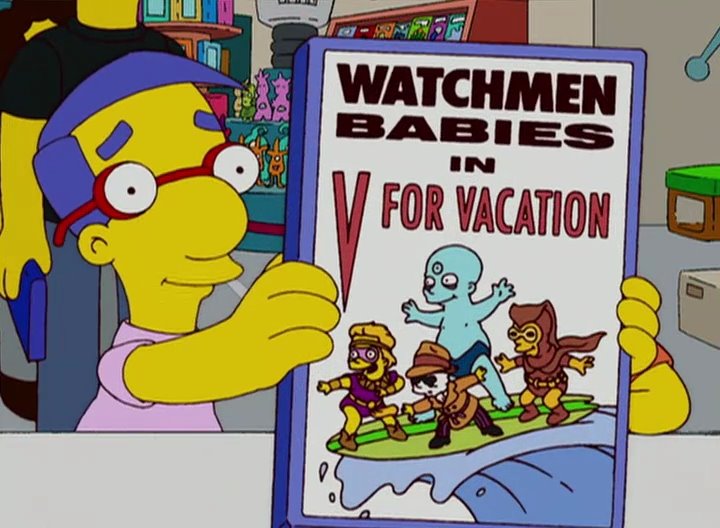
Image Credit: Milhouse knows the score. Screen-grab from The Simpsons.

Labels: , , , , , ,


Sunday, September 17, 2006

Dissecting the Crossroads of Infinity

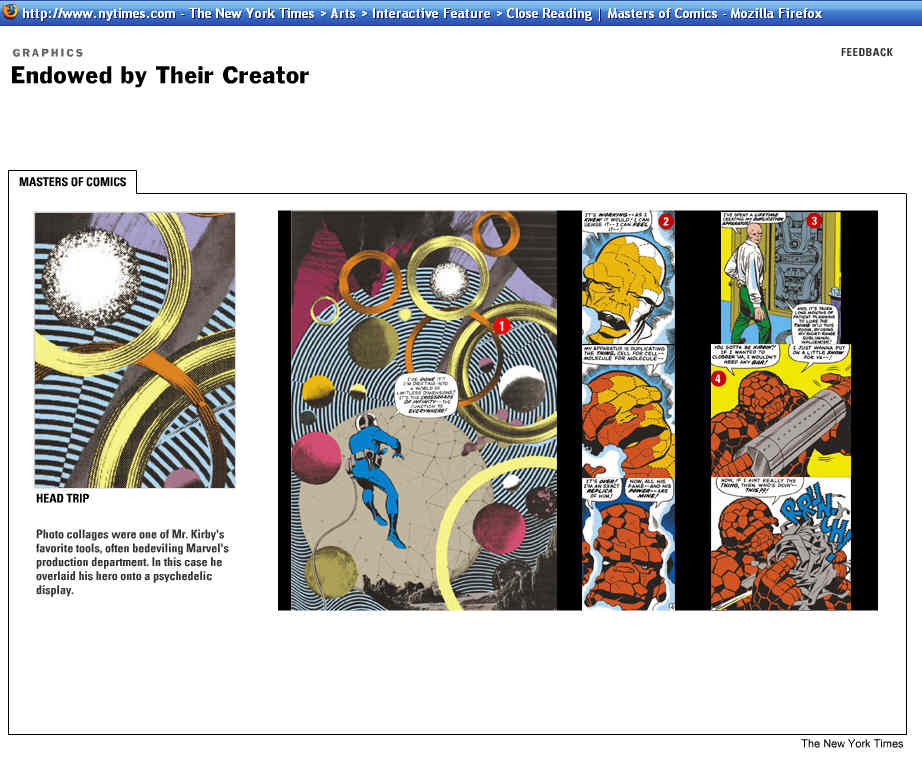
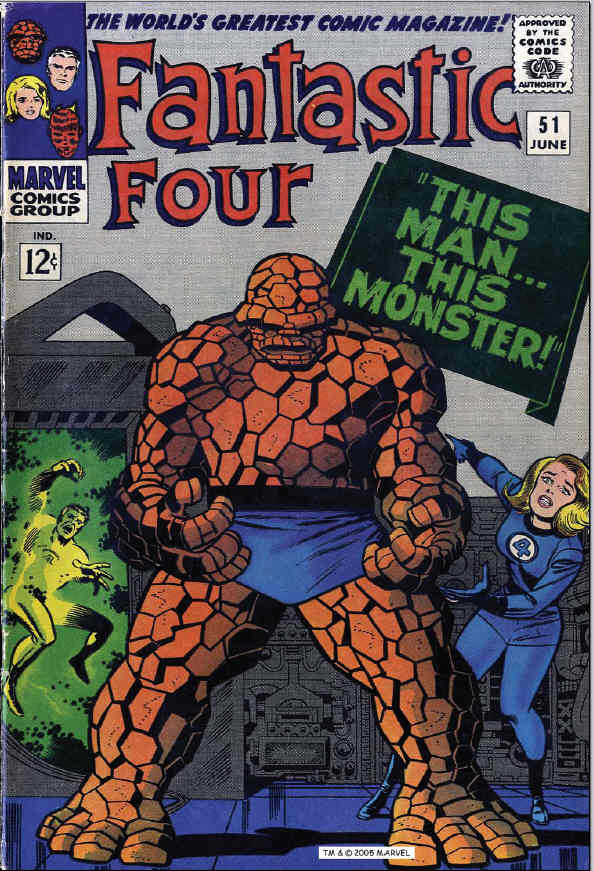
The Sunday Arts section of The New York Times often features a "Close Reading" of artwork currently on display in the city. Today, commemorating the opening of the traveling exhibition "Masters of American Comics," critic George Gene Gustines turns his critical eye toward the work of Jack Kirby - specifically, images from the landmark comic book Fantastic Four #51, cover-dated June, 1966. The column is reproduced as an interactive slideshow at the Times' website (link also currently available off this page).

Gustines does a fine job of highlighting some of "King" Kirby's techniques and quirks in this brief overview, from the cartoonist's fondness for collage (never reproduced adequately in the original comic books) to his fantastic machinery designs. (If only he'd been able to cover some Kirby Krackle, as well!)

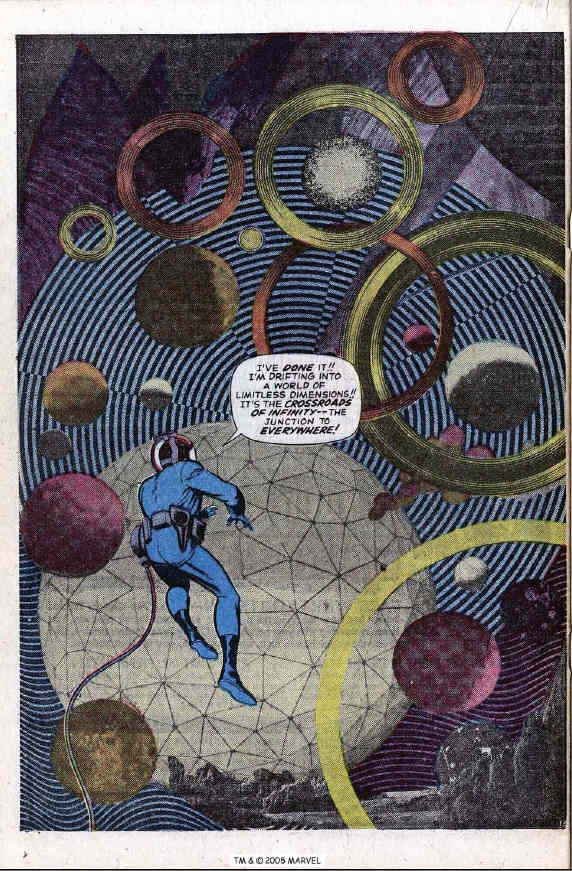
Since you can read Gustines' comments at the link, I thought I'd take the opportunity to showcase a few more images from this story. First, for comparison, here's the collage example discussed in the article as it was originally published. When you compare it to the article's recolored version, you can see how 1960s-era comic book publication techniques did Kirby's photo collages no favors:

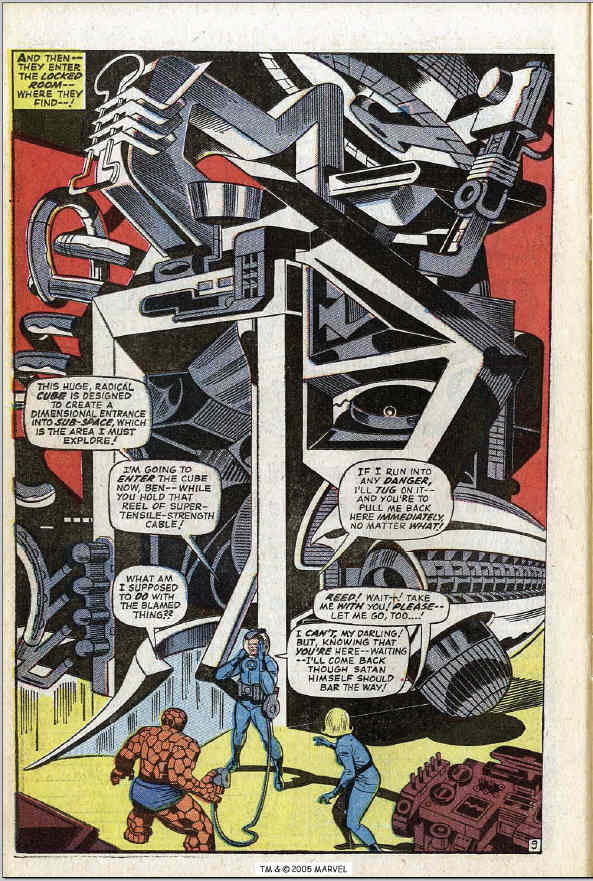
When it comes to machine design, the article's curiously labeled "Deep Closets" example can't compare to one of my favorite Kirby machines of all time, also conveniently featured in this issue - in fact, it's the machine Reed Richards (Mr. Fantastic) designs to allow him to travel to the "world of limitless dimensions" above:

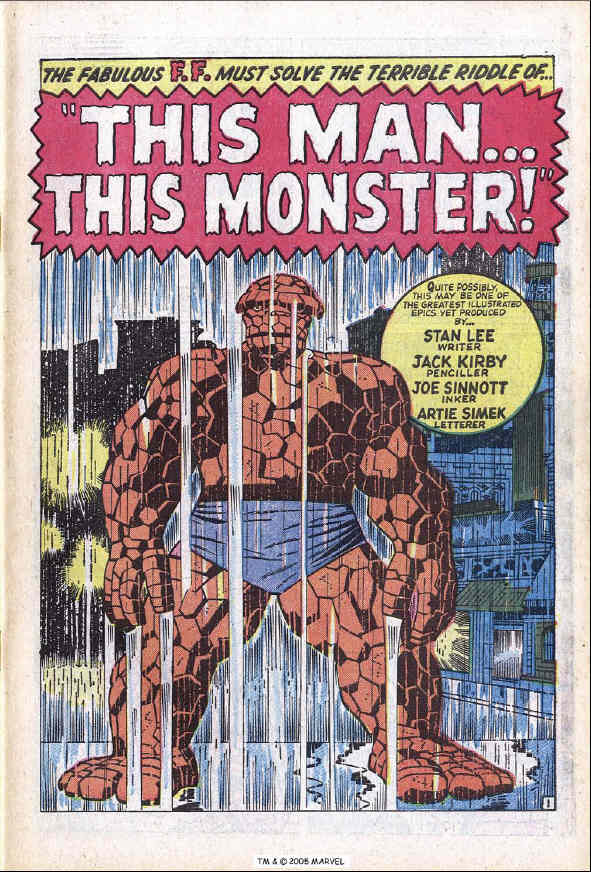
And finally, no discussion - however brief - of FF #51 should ignore the issue's iconic splash page, featuring a rain-soaked, silent portrait of Ben Grimm (The Thing). True, there's some of Stan Lee's trademark, over-the-top editorial matter plastered on the page, but in terms of the story itself, the image remains silent. The absence of dialogue or even narration renders the drawing a portrait of isolation - an isolation further enhanced by the nighttime rain shower which pelts the pavement and the morose Grimm alike.

Lee rarely passed up the opportunity for snappy dialogue or "hipper-than-hip" narration, here he wisely allows Kirby's artwork to speak for itself. The somber tone perfectly prepares the reader for the story that follows, a superhero story in which "super powers" are used only twice: once when the impostor-Thing crushes a small metal canister, and once when Johnny Storm, the Human Torch, reluctantly sets his thumb ablaze to satisfy the curiosity of his gawking, fellow college students.

Here's hoping Gustines' article piques the curiosity of Times-readers who might otherwise have passed up the opportunity to visit this show. Masters of American Comics is on display until January 28th, 2007, with half at The Newark Museum (Masters Info) and half (including Kirby) at The Jewish Museum (Masters Info). The latter also is hosting a companion exhibit, Superheroes: Good and Evil in American Comics. Having missed the "Masters" exhibit's previous stops in Los Angeles and Milwaukee, I hope to visit these soon.

Update: Wow, I can't believe I forgot to mention the monumental exhibit catalog (perhaps because I haven't got a copy yet, myself):
Masters of American Comics. Ed. John Carlin, Paul Karasik, and Brian Walker. Yale University Press, 2005. 328pp.
Image credits: Top, the Times website; the rest are reproduced from the 44 Years of Fantastic Four dvd-rom. As noted on the FF images, they're all ™ and © 2005 Marvel.

Labels: , , , , , , ,


Friday, April 07, 2006

Lynda Barry = Cruddy-est Funk Queen of the Universe, Ever

Whenever I have a pressing "To-Do List," I always seem to gravitate towards #2 on that list, not #1 - no matter how much I want to do #1.

#2 on my list right now - the thing the last few posts here have covered - is the revamping of ComicsResearch.org. But I do have another, more pressing issue. (OK, maybe I've got more than one "more pressing" issue at present, but I do what I can.)

But #1 - ahhhh, #1. For the Comic Art & Comics area of next week's annual meeting of the Popular Culture Association, I proposed an essay entitled "'Whenever Possible, Be the Unexpected': Approaches to Lynda Barry's Cruddy". If you haven't read Cruddy: An Illustrated Novel, but you love poetically written, well-characterized, unflichingly dark but absolutely hilarious fiction - and you have a strong stomach - Cruddy is your book, hands down.

Check out Cruddy's Amazon.com entry - you can read the first chapter or two there. Then read chapters four and five at the Simon & Schuster website. That'll give you a small taste of what's to come. (You don't even meet the cream of the character crop, the delightfully well-spoken "Suzy Homemaker," until about 2/3 of the way in.)

What's that? You don't know about the sublime cartooning genius of Lynda Barry? The creator of the #1 Poet, Fred Milton: Beat Poodle? Well, what are you waiting for?

OK, this post served its purpose; now I'm ready to get back to work on that essay!

Labels: , , , ,


Saturday, December 03, 2005

Ditko = Ditko

I first discovered cartoonist Steve Ditko's work in the pages of Amazing Spider-Man - or, more accurately, in Pocket Books' three-volume Spider-Man Classics series, published in the late 1970s. Technically, the first Ditko art I saw must have been in Origins of Marvel Comics- but the Pocket Spider-Mans gave me hundreds of pages of Ditko artwork, and I devoured them all, over and over again. Ross Andru was the current Spider-Man artist at the time, and I liked that work a lot; but the old books drawn (and often plotted) by Ditko were quirky, instantly recognizable, intensely felt: They were magic, and I couldn't get enough of them (or reprints of his early work on Doctor Strange). Fans of Ditko's Marvel-era work will be interested in the recent Marvel Visionaries: Steve Ditko volume, at right.

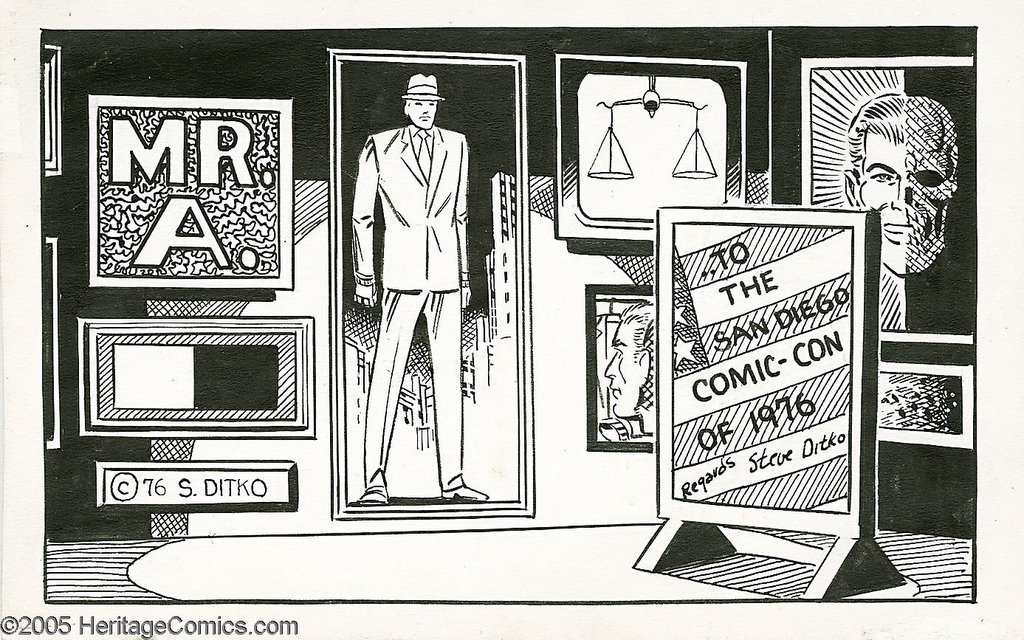
It wasn't until years later that I discovered Ditko's own, more personal work, on characters like Static, The Mocker, and - of course - Mr. A (you might still find copies of The Ditko Collection, with lots of Mr A., if you're lucky.) Ditko had become a student of Ayn Rand, and Mr. A. was the living embodiment of Rand's philosophy of "Objectivism": A is A. In Mr. A's world (and in Ditko's) there can be no moral grey areas; there is good, and there is evil, and there is nothing else. I think the icongraphy in the following image (from the Heritage Comics website) makes the stark argument quite clearly, itself:


While I find Ditko's personal work fascinating, I can't say that I could ever agree with it philosophically; I guess I'm too much of a grey-area kind of person. But that doesn't mean that I can't enjoy Mr. A; it's clearly passionate, heart-felt work. How many commercial artists of any stripe are that willing to put their innermost beliefs down on the page, this starkly, with no apologies or hedging?

Thanks to a post by Dr. Chris R. Tame on the Ditko-Kirby email list, I was happy to learn about the following article:
"The Illustrated Rand", by Chris Matthew Sciabarra. The Journal of Ayn Rand Studies 6.1 (2004): 1-20. (Download a PDF version of the entire article here.)
The article, part one of two, catalogues Rand's cultural influence by listing some of the scores of academic journals, magazines, televsion shows, and more media which have quoted or mentioned Rand's work. Unfortunately, the bulk of the article is little more than a list. There's precious litle analysis here, although there may be more extended discussions in part two, which I haven't yet read. We don't even learn if most of these mentions are positive or negative, informed or throw-away.

The largest section of the article by far, however, is devoted to Steve Ditko and Frank (Sin City) Miller (pages 8-12). While the section includes several meaty Mr. A quotes, we still don't find much in the way of analysis. I'd love to learn more about how Objectivism plays out in Ditko's work: How accurately does his work embody the philosophy? Does Ditko's thought expand on, embellish, or even contradict Rand's? Again, perhaps I'm asking too much of an admitted "overview" article; but if anyone out there knows of more critical looks at Ditko's pesonal work, I'd love to hear about them.

And since I haven't mentioned it yet, the premiere website for Ditko is Blake Bell's Ditko Looked Up. Watch for Blake's Steve Ditko: Mysterious Traveller, a biography forthcoming from Fantagraphics. I'm sure that Blake's book will get into the questions I've asked above - and more - with relish.

Labels: , , , ,


Sunday, November 20, 2005

Comic Book Artist's Will Eisner Tribute: Some Things are Worth Waiting For

Thanks both to a phone call from pal The joey Zone and the fine folks at the Will Eisner Discussion List, I learned yesterday that the long-awaited Will Einser tribute issue of Comic Book Artist magazine was now available in finer comics shops.

Eisner, who passed away January 3, 2005, was one of the most important and influential cartoonists this country has produced, with a career spanning the growth of the modern comic book. From his 1940s creation of the newspaper comic-book insert, featuring The Spirit, to his later kick-starting the "graphic novel" movement in the 1970s, and beyond, Esiner's impact on comics can't be overstated. Rather than go into detail here, I'll point you to his website's short but comprehensive biography. More information about Eisner may be found at my ComicsResearch.org; watch for even more there soon.

Kate and I caught a glimpse of the issue at one of Houston's Bedrock City Comics shops, and believe me, this looks like a true "must-have" for anyone interested in Eisner's work or even in comics in general. It's chock-full of interviews with - and essays & artwork by - dozens and dozens of cartoonists, writers, editors, publishers, friends, students, disciples, and more.

Full disclosure: Thanks to editor Jon B. Cooke's prodding, I've got a page-long essay in this tome myself; I also helped out a bit in the editing department, for which I was amazed to learn that Jon rewarded me with the title "Special Contributing Editor." Yowza!

I'll post a more in-depth review once I've received my own copy; but I wanted to alert folks here about it now, since it's sure to disappear from the shelves quickly. At nearly 200 pages (including several gorgeous color sections) for only about $15, it's a steal - or a sound investment, depending on your temperament. Pick up a copy at your local comics shop, or order on-line via Top Shelf Comix. And several books written, edited, or worked on by Messr. Cooke are available via Amazon.com.

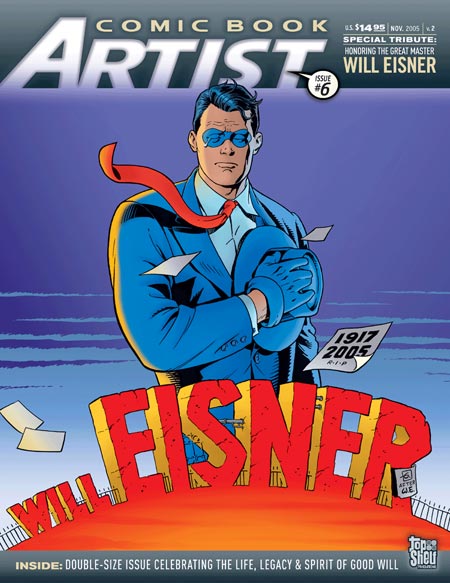
Above: Dave Gibbons' beautiful, respectful cover to CBA v2 no6.

Labels: , , , ,


Monday, April 25, 2005

New York Times' Comics Forum: Keeping the "Mess" in "Message Board"

As Tom Spurgeon at Comics Reporter rightly notes, the New York Times Book Review's April 24 piece on comics does read like something out of the past - why the Review devoted so much space to this type of superhero-influenced review is a bit puzzling, especially given its recent coverage of Spiegelman and Satrapi and David B., among others. (Note: Registration required to view any Times links. Don't want to register? No problem!)

What's also puzzling - no, more like extremely disappointing - is the Times' new Readers Forum on Comics. I spent an hour or so making my way through the posts there, and oh my Lord - if you think (as I do) that the "wheat/chaff" and "thoughtful poster/moron" ratios are usually pretty low on comics-related message boards, try slogging through this one. I had naively assumed that the Times On-Line would attract a more contemplative, erudite, and open-minded audience. Stupid, stupid Gene...

The Forum opened April 16, to coincide with the Times' preview of Will Eisner's The Plot; unfortunately, it also coincided with a revamp of the Forums as a whole. So a large part of the first week's postings are written by Forum regulars who are angry that the previous Forums on Shakespeare and Nabokov, for example, were "replaced" by the Comics Forum. From what I can tell, it's not a "replacement" so much as a "restructuring" and an unfortunate bit of timing; but these folks in general can't seem to tell their post hoc from their propter hoc.

What we do get, however, are the predictable laments about the end of civilization. And also some fairly ignorant comments about Eisner's The Plot, from considering it a joke to questioning the need for any such book in the first place to - I'm being serious here - calling Eisner a Spiegelman clone. And of course, the ever-popular "expert opinion":
Look at that guy at the top of the page, pretending this is about "literary" comics like Maus, as if there were more than about five of them.
To be fair, there are some knowledgeable defenders of the forum. For the most part, though, even those who do know something about comics rarely get past recommending Sandman or "more sophisticated" superhero books. I like Sandman and Watchmen, but I wouldn't consider either of them to be good "gateway drugs" for the curious but clueless would-be comics reader.

I realize that a message board can only be as good as the people who post in it, and I suppose I have no real right to complain about the Times forum, since I haven't contributed anything myself. But seeing the small-mindedness and petty carping there only reinforces my opionion of message boards as places generally to avoid. I've occasionally found useful info at places like the Comics Journal boards, but then we're back to the whole "wheat/chaff" thing...

If anyone knows of any good comics-related discussion boards - forums where people actually pay attention to other's ideas, and where, come to think of it, people actually have ideas - I'd love to hear about them.

Labels: , ,


Tuesday, March 22, 2005

The Ad that Made an Icon out of MAC!

Pow![Horn-Tootin' Dep't] In 1996 I attended the Popular Culture Association's national conference, where I presented a paper on Charles Atlas ads and some of their many parodies. (A sample panel from one of the ads is displayed at left.) I later turned that essay into an article for the Winter 2000 issue of Hogan's Alley (for you bibliography buffs, that's issue 7, pages 80-87, according to my horribly out-of-date c.v.). The HA website recently posted my article, along with a few small illustrations.

I had heard they were planning to do so a couple of years ago, but I think they just got around to it recently - not surprising, given how much work goes into each issue. The website has also archived features like their interview with Bizarro's Dan Piraro and an essay on Johnstone and Cushing, the advertising company behind classics like Postum's pesky nemesis, Mr. Coffee Nerves.

Labels: ,