Thursday, March 23, 2017

Comics Alternative Podcast: Brian Cremins Interview


I'm back on a very special (for me, at least) episode of The Comics Alternative! This week I join regular co-hosts Derek Royal and Andy Kunka for an interview with Brian Cremins, Harper College professor of English and author of Captain Marvel and the Art of Nostalgia (University Press of Mississippi).

Why is this episode special to me? Because Brian and I met as graduate students at the University of Connecticut more than two decades ago, and he's one of my closest friends. When I moved to the Chicago area a couple of years ago, Brian and his partner Allison Felus welcomed me to town and helped make me feel at home with their friendship and generosity (and their musical appearances!).

Plus, of course, there's Brian's book, which is thoughtful, articulate, and unexpected as academic monographs go. It's smart and engaging, and quite personal at the same time. Brian's answers in this interview will give you a very good idea of the wide-ranging ideas and topics you can expect when you read his book. And you should! 

As always, click the link above to stream the episode, or you can subscribe via iTunes or many other streaming services.

Labels: , , , , , , , ,


Monday, June 15, 2015

CFP: The Comics of Julie Doucet and Gabrielle Bell (collection; Aug. 15)

Call for Papers
The Comics of Julie Doucet and Gabrielle Bell
(an edited collection)

This proposed volume for the University Press of Mississippi's book series, Critical Approaches to Comics Artists, will examine the works of two influential cartoonists: Julie Doucet and Gabrielle Bell. These artists have helped shape the world of contemporary comics, particularly through their experiments in autobiography, travelogue, fantasy, and diary.

We are interested in assembling a tightly woven collection of compelling essays from a variety of disciplinary and interdisciplinary perspectives in order to suggest starting off points for sustained future critical analysis. Each essay may examine the works of one or the other cartoonist, or it may put historical and aesthetic discussions of their works in conversation with one another. Some of the critical approaches we hope to encounter include: comics and visual studies, art history, print and material culture studies, women's and gender studies, and auto/biography studies.

General topics potential contributors may choose to address in discussing the works of one, the other, or both cartoonists include:

  • diaries, travelogues, and dream journals
  • representations of gender and sexuality
  • adaptations (film, etc.) and/or translations
  • auto/biography and/or gender and genre
  • urban landscapes and interiors
  • comics genealogies and networks
  • technology and comics
  • place and origin: Quebec/England/San Francisco/New York
  • graphic medicine (epilepsy, depression)
  • self-publishing, zines, and mini-comics
  • career trajectories
  • ]anthologies/anthologizing; comics publishers/publishing (L'Association, Drawn & Quarterly, website, self, etc.)
  • art books and/or non-narrative works
  • non-comics works and methods (collage, poetry, animation, silkscreening, etc.) 

In the form of a Word file or PDF, please send a 500-1000 word abstract, CV, and contact information to Tahneer Oksman and Seamus O'Malley at bellanddoucet [at] gmail.com by August 15.

Labels: , , , , ,


Tuesday, July 02, 2013

CFP: The Comics of Hergé / essay collection (Jan. 1, 2014)

As posted on the Comics Scholars' list...
 
Call for Papers
The Comics of Hergé

The Comics of Hergé is a proposed volume in a new book series, Critical Approaches to Comics Artists, at the University Press of Mississippi. This volume will contain 12-16 new critical essays on Hergé, ranging from his work in advertising, illustrations for others' writings, and comics to film and television adaptations of his work. Essays from many disciplinary perspectives are welcome, including critical approaches from comics studies, art history, cultural studies, religious and ethical studies, literary studies, linguistics, history, political science, gender theory, postcolonial studies, and adaptation theory.

Essays (in English) might address the following questions:
  • What important connections can be made between Hergé's non-comics work—for example, his illustrations for Léon Degrelle and his work in advertising—and the work for which he became famous?
  • Although analysis of Hergé's work has focused almost exclusively on Tintin, how would our understanding of his masterpiece benefit from better attention to his lesser-known comics? How has the previous focus on Tintin denied important insights on these works?
  • How did Hergé's growing interest in modern art change the work he did in comics?
  • How has Hergé's ligne claire influenced or been challenged by subsequent artists, including those with whom he worked over his long career?
  • How do Hergé's ideas of eastern religions come through in his interviews and/or art? To what extent were these ideas accurate, and how do those ideas illuminate other aspects of his life and art?
  • To what extent does Tintin's nationality, increasingly obscured over the course of the series, matter? To what extent does his status as a citizen of Brussels signify in the ongoing internal tensions of Belgium?
  • Some important comics creators—such as Edgar Jacobs and Jacques Van Melkebeke—benefitted from and have been overshadowed by Hergé. What new research can shed light on Hergé’s relationship with these creators and how that relationship affected comics?
  • How does Hergé obscure sexual desire in his works, and where does it appear despite his efforts? Is there a difference between his treatment of desire in his works for different audiences?
  • What other absences does Hergé enforce in his comics, and to what effect?
  • Numa Sadoul’s book of interviews with Hergé—interviews Hergé edited before they saw print—remains pivotal to the study of Hergé long after its publication. What arguments, revisions, insights, expansions, or even corrections are now necessary?
  • Other topics are also very welcome.
Please send a 500-word abstract along with CV and contact information to Joe Sutliff Sanders at joess@k-state.edu by January 1, 2014.

Labels: , , , , , , , ,


Thursday, May 30, 2013

CFP: The Comics of Charles Schulz / edited collection (Oct. 31)

Call for Papers
The Comics of Charles Schulz
edited by Jared Gardner
Abstract Deadline: October 31, 2013

The Comics of Charles Schulz: The Good Grief of Modern Life is a proposed volume in the new book series, Critical Approaches to Comics Artists, at the University Press of Mississippi. This volume will contain an array of critical essays on the comics of Charles Schulz, best known for Peanuts, the nationally-syndicated daily comic strip that ran for fifty years and which remains today the most recognizable strip worldwide. Essays from many disciplinary and interdisciplinary perspectives are welcome, including critical approaches from comics studies, art history, cultural studies, literary studies, philosophy, history, and political science.
Essays that address the following topics are especially welcome:
  • Influences & relationship to earlier comics
  • Philosophy & Ethics
  • Suburbia
  • Politics
  • Repetition and seriality in Peanuts
  • Psychological and social identities in Peanuts
  • Peanuts & the 1950s, 60s, 70s, etc.
  • Peanuts across media
  • Peanuts and global merchandizing
Please send a 500-1000 word abstract, 3-page CV, and contact information to Jared Gardner at gardner.236@osu.edu by October 31, 2013.
Accepted abstracts will be used in a formal book prospectus, and the deadline for full-length essays will be negotiated shortly thereafter.

Labels: , , , , ,


Wednesday, May 19, 2010

PR - Drawing France: French Comics and the Republic, by Joel E. Vessels

A press release I received today. I've met Joel Vessels, and I expect this book to be a must-read.

Drawing France:
French Comics and the Republic
By Joel E. Vessels
University Press of Mississippi
ISBN 978-1-60473-444-7, hardback $50

For Immediate Release

Rise of Bande Dessinée transformed French politics and history

In France, Belgium, and other Francophone countries, the comic strip - called bande dessinée (BD) in French - has long been considered a major art form capable of addressing cultural issues. Graphic narratives were deemed worthy of canonization and critical study for decades before the academy and the press embraced comics in the United States.

The place that BD holds in the culture today, however, belies the contentious political route the art form has had in France. In Drawing France: French Comics and the Republic (University Press of Mississippi) author Joel E. Vessels examines the trek of BD from its course of being considered a fomenter of rebellion, to an art suitable only for semi-literates, to an impediment to children’s education, and most recently to its use as a bellwether of social concerns in mainstream culture.

In the mid-1800s, alarmists feared political caricatures might incite the ire of an illiterate working class. To counter this notion, proponents yoked the art to a particular articulation of “Frenchness” based on literacy and reason. With the post-World War II economic upswing, French consumers saw BD as a way to navigate the changes brought by modernization.

After bande dessinée came to be understood as a compass for the masses, the government, especially François Mitterand’s administration, brought comics increasingly into “official” culture. In tracing this development, Vessels argues that BD are central to the formation of France’s self-image and a self-awareness of what it means to be French.

Drawing France is one of the first texts to directly examine the French government’s relationship to bande dessinée and popular visual culture to analyze the political identity of the modern nation-state.

Joel E. Vessels, Astoria, New York, is instructor of history at Nassau Community College. His work has appeared in International Journal of Comic Art and Contemporary French Civilization.

–30–

For more information contact Clint Kimberling, Publicist, ckimberling@mississippi.edu

Read more about Drawing France: French Comics and the Republic at http://www.upress.state.ms.us/books/1296

Labels: , , , ,


Tuesday, January 19, 2010

A COMICS STUDIES READER Wins the 2009 Peter C. Rollins Book Award

As posted today at the blog for the University Press of Mississippi,
A Comics Studies Reader has just been named winner of the 2009 Peter C. Rollins Book Award by the Southwest Texas Popular/ American Culture Association. This prize is awarded annually for the best book in popular culture studies and/or American culture studies.

Editors, Jeet Heer and Kent Worcester have been honored for their exemplary work in the popular culture field. Designed to reward genuine research and lucid expression, the award bears the name of Peter C. Rollins, Founder of the SWTX organizations.
See UPM's original blog post for more information. Congratulations, Jeet and Kent!

Full, proud discosure: This book reprints my essay on Chris Ware. You can see the book's complete table of contents at its ComicsResearch.org page.

Labels: , , ,


Thursday, July 23, 2009

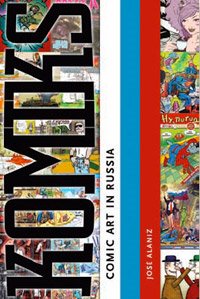
New Book from UPM - Komiks: Comic Art in Russia

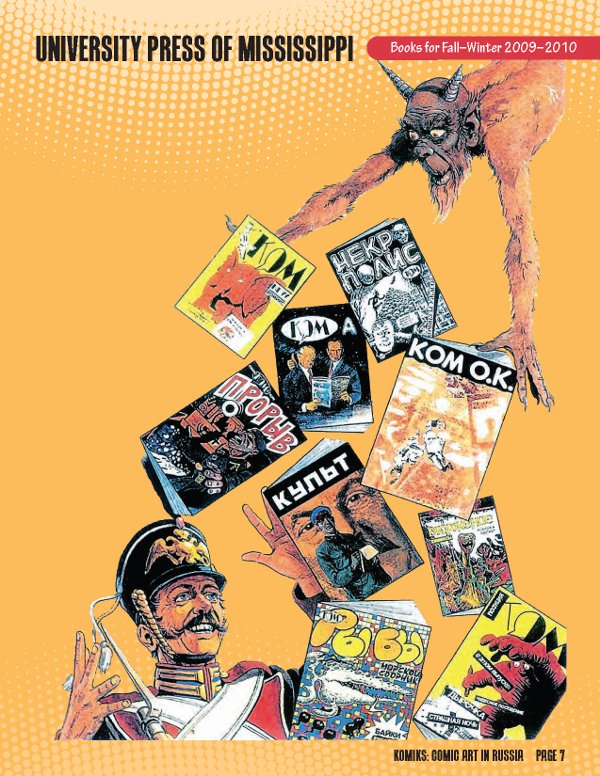
As many followers of this blog already know, the University Press of Mississippi has been "the comics scholar's best friend" for nearly two decades, beginning with their publication of M. Thomas Inge's Comics as Culture in 1990. February 2010 will see UPM release José Alaniz' Komiks: Comic Art in Russia, which is featured on the front cover of their Fall-Winter 2009-2010 Catalog (view online or download the PDF). I'm happy and honored to have know José for many years, and I've heard bits and pieces of this book at various conferences, so I know that Komiks will be not only authoritative but interesting as all get-out. Congtratulations on making the cover, José!
Komiks: Comic Art in Russia
José Alaniz

The first study to trace the evolution of Russian comics
from Soviet bête noire to post-Perestroika art form

José Alaniz explores the problematic publication history of komiks -- an art form much-maligned as "bourgeois" mass diversion before, during, and after the collapse of the USSR -- with an emphasis on the last twenty years. Using archival research, interviews with major artists and publishers, and close readings of several works, Komiks: Comic Art in Russia provides heretofore unavailable access to the country’s rich—but unknown—comics heritage. The study examines the dizzying experimental comics of the late Czarist and early revolutionary era, caricature from the satirical journal Krokodil, and the postwar series Petia Ryzhik (the "Russian Tintin"). Detailed case studies include the Perestroika-era KOM studio, the first devoted to comics in the Soviet Union; post-Soviet comics in contemporary art; autobiography and the work of Nikolai Maslov; and women's comics by such artists as Lena Uzhinova, Namida, and Re-I. Alaniz examines such issues as anti-Americanism, censorship, the rise of consumerism, globalization (e.g., in Russian manga), the impact of the internet, and the hard-won establishment of a comics subculture in Russia.

Komiks have often borne the brunt of ideological change—thriving in summers of relative freedom, freezing in hard winters of official disdain. This volume covers the art form's origins in religious icon-making and book illustration, and later the immensely popular lubok or woodblock print. Alaniz reveals comics' vilification and marginalization under the Communists, the art form's economic struggles, and its eventual internet "migration" in the post-Soviet era. This book shows that Russian comics, as with the people who made them, never had a "normal life."

José Alaniz is associate professor of Slavic languages and literatures and comparative literature at the University of Washington, Seattle. His work has appeared in the International Journal of Comic Art, Comics Journal, Studies in Russian and Soviet Cinema, Ulbandus, and other periodicals.
FEBRUARY, 288 pages (approx.), 6 x 9 inches
21 color and 69 b&w illustrations, bibliography, index
Cloth $38.00, 978-1-60473-366-2


Image credits: Top: UPM's website. Bottom: UPM's Fall-Winter 2009-2010 Catalog.

Labels: , , , , ,


Wednesday, April 22, 2009

University Press of Mississippi: Website Super Sale (ends July 15, 2009)

University Press of Mississippi, which has published more books about comics than any other academic publisher in the USA, currently is running a large sale for web-only purchases. Not every title is on sale, but a goodly number are, at 20% to 85% Off. The sale ends July 15th.

Luckily for comics scholars, UP Miss provides a breakdown of sale titles by subject. So click here for their list of discounted books on comic art.

Also: Check out UP Miss's blog. (But no tags?!? I will speak to them about this. srsly.)

Labels: , , ,


Saturday, December 15, 2007

Publication: Conversations with Art Spiegelman

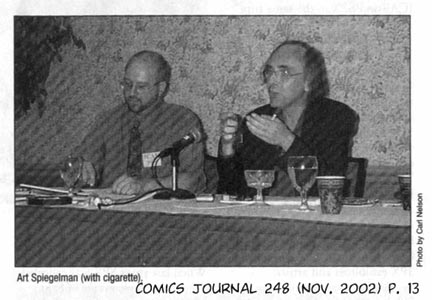
In 2002 I was invited to interview Art Spiegelman at the International Comic Arts Festival; the event was co-sponsored by the Small Press Expo. I admit to being a bit nervous at the time: It was the first time I'd interviewed anyone, let alone someone I'd written about in my dissertation. Doing so in front of a large crowd didn't help, either. But Spiegelman certainly did; he's not just a ready speaker, but very articulate about his (and others') work.

I made sure to record the interview (thanks for the help, Mark Nevins!), which was fortunate. Joseph Witek, author of Comic Books as History, later contacted me about including a transcript of the interview in his upcoming volume for the University Press of Mississippi entitled Art Spiegelman: Conversations.
The book was published earlier this year, and it's quite an impressive volume. It'll prove to be a valuable book to scholars, of course. But Spiegelman's gift for analysis (and of gab!) makes the book a great read for anyone interested in comics as an art form. It's a worthy addition to UPM's essential Conversations with Comics Artists Series. (Naturally, I'd say all of this even if I hadn't contributed to it.)

Click here for ComicsResearch.org's listing for
Art Spiegelman: Conversations.

Image: Photo from The Comics Journal's coverage of ICAF/SPX. Although I had written for TCJ for many years, the caption-writer obviously felt that given the choice between identifying me or Spiegelman's cigarette, the smoke was the more well-known participant.

Labels: , , , , , ,


Saturday, October 13, 2007

UP Mississippi Books on Sale

Attention bargain shoppers: The University Press of Mississippi is running a huge sale, with discounts from 40% to 85%. The sale pertains only to selected on-line book purchases, and it ends November 15, 2007.

Click here for the entire list of sale titles. While the list reflects UPM's broad range of publishing interests, ComicsResearch.org readers will be interested especially in these titles:
Update (10/15/2007): UPM has long been an enthusiastic supporter of comics scholarship, and we're happy to spotlight their sale. Be sure to check it out! And while you're there, check out their entire list of comics-related books.

Also: You might not be aware that UPM now uses print-on-demand to bring back out-of-print titles. So while they're not part of this sale, you now can stock your library with any of the older and essential titles you might have missed, like M. Thomas Inge's Comics as Culture, Joseph Witek's Comic Books as History, Amy Nyberg's Seal of Approval, and many more.

PS: Don't forget that we include expanded information on nearly all of these books at
ComicsResearch.org!

Labels: , , ,