Tuesday, November 12, 2013

CFP: The Sequential Art: Bandes Dessinées as a Cultural Nexus / Prague (Nov 15; Dec 13-14)

Call for Papers for a Panel:
The Sequential Art:
Bandes Dessinées as a Cultural Nexus
(As part of the Second Global Forum of Critical Studies
organized by Euroacademia in Prague, Czech Republic)
Prague, Grand Majestic Plaza,
December 13 - 14, 2013
Deadline 15 November 2013
PANEL DESCRIPTION:
“Comics are just words and images. You can do anything with words and images.” Harvey Pekar
The phenomenon known as comics, bandes dessinées, graphic story or fumetti was first defined as sequential art by Will Eisner in his work Comics and Sequential Art (1985). Further inquiries were led by Scott McCloud (Understanding Comics) or Benoît Peeters (Lire la bande dessinée) in trying to establish a theoretical framework for this mean of expression. After a long period of being perceived as a childish form of entertainment, nowadays the sequential art is a well-known and respected form of art and it has even became the field of academic research.
This panel aims to feature the transdisciplinarity of its subjects and its methods, to bring together different ways of approaches, and to highlight its numerous possibilities of cultural dialogue. The panel welcomes contributions regarding the following topics, but any other paper or subject related to sequential art are most appreciated:
  • Mainstream, independent and underground comics traditions
  • How comics have been a way of expression to social and historical subjects
  • Theoretical and critical approaches of comics
  • Otherness in comics: depiction of exotic places and alterity
  • The Superhero prototype: a way of understanding the American way of life?
  • The Space In Between. On Time and Space in comics
Phenomenological interpretations:
  • The connection between comics and architecture: François Schuiten – Les cités obscures
  • Comics versus Movies
Please see the complete details of the conference at:
If you are interested to apply you can use the on-line application form on the conference website or send your 300 words abstract together with the name and affiliation until 15th of November 2013 to
Reference / Quellennachweis:
CFP: Bandes Dessinées as a Cultural Nexus (Prague, 13-14 Dec 2013). In:
H-ArtHist, Nov 7, 2013. <http://arthist.net/archive/6372>.

Labels: , , , ,


Tuesday, July 02, 2013

CFP: The Comics of Hergé / essay collection (Jan. 1, 2014)

As posted on the Comics Scholars' list...
 
Call for Papers
The Comics of Hergé

The Comics of Hergé is a proposed volume in a new book series, Critical Approaches to Comics Artists, at the University Press of Mississippi. This volume will contain 12-16 new critical essays on Hergé, ranging from his work in advertising, illustrations for others' writings, and comics to film and television adaptations of his work. Essays from many disciplinary perspectives are welcome, including critical approaches from comics studies, art history, cultural studies, religious and ethical studies, literary studies, linguistics, history, political science, gender theory, postcolonial studies, and adaptation theory.

Essays (in English) might address the following questions:
  • What important connections can be made between Hergé's non-comics work—for example, his illustrations for Léon Degrelle and his work in advertising—and the work for which he became famous?
  • Although analysis of Hergé's work has focused almost exclusively on Tintin, how would our understanding of his masterpiece benefit from better attention to his lesser-known comics? How has the previous focus on Tintin denied important insights on these works?
  • How did Hergé's growing interest in modern art change the work he did in comics?
  • How has Hergé's ligne claire influenced or been challenged by subsequent artists, including those with whom he worked over his long career?
  • How do Hergé's ideas of eastern religions come through in his interviews and/or art? To what extent were these ideas accurate, and how do those ideas illuminate other aspects of his life and art?
  • To what extent does Tintin's nationality, increasingly obscured over the course of the series, matter? To what extent does his status as a citizen of Brussels signify in the ongoing internal tensions of Belgium?
  • Some important comics creators—such as Edgar Jacobs and Jacques Van Melkebeke—benefitted from and have been overshadowed by Hergé. What new research can shed light on Hergé’s relationship with these creators and how that relationship affected comics?
  • How does Hergé obscure sexual desire in his works, and where does it appear despite his efforts? Is there a difference between his treatment of desire in his works for different audiences?
  • What other absences does Hergé enforce in his comics, and to what effect?
  • Numa Sadoul’s book of interviews with Hergé—interviews Hergé edited before they saw print—remains pivotal to the study of Hergé long after its publication. What arguments, revisions, insights, expansions, or even corrections are now necessary?
  • Other topics are also very welcome.
Please send a 500-word abstract along with CV and contact information to Joe Sutliff Sanders at joess@k-state.edu by January 1, 2014.

Labels: , , , , , , , ,


Wednesday, May 29, 2013

BD & Comics Passion in London (30 May - 2 June 2013)

A quick, last-minute announcement of an event in London I dearly wish I could attend...

BD & Comics Passion
30 May - 2 June 2013

This year's edition will feature extraordinary creators including Posy Simmonds, Edika, Glen Baxter, Etienne Davodeau, Marc-Antoine Mathieu, Régis Loisel, Hunt Emerson, Pénélope Bagieu and more. Once again, the programme will prove “as imaginative as the work itself” (Metro) with talks, workshops, live drawing, and groundbreaking events such as Drawing Jams, and Drink & Draw, a one of a kind event mingling live drawing and wine tasting led by renowned British Master of Wine Tim Atkin.

Labels: , , , ,


Saturday, June 09, 2012

CFP: International French-Language Comics Conference (July 25; Nov. 2-3)


Call for Papers
International French-Language Comics Conference
Miami University (Oxford, Ohio, U.S.A.)
2-3 November 2012

Papers
Critical and theoretical presentations in all areas of French-language comics are invited. The conference will help consolidate recent gains in English-language scholarship on French-language comics and will showcase new avenues of research. Publication of revised versions of a selection of the conference papers is planned in the peer-reviewed journal European Comic Art (http://journals.berghahnbooks.com/eca/).

Proposals
Please send the following material in a Word document (doc or docx) to Mark McKinney (mckinnm@muohio.edu) by 25 July 2012: a 150-word abstract and a 100-word bio-bibliography. All presentations will be in English.

Keynote speakers
Clément Baloup, a cartoonist of Vietnamese and French heritage, has published several graphic narratives devoted to Vietnamese and other groups in France and elsewhere from the colonial period to the present. These include two historical fictions, both with Mathieu Jiro: Le chemin de Tuan [Tuan's Way] (Seuil, 2005) and Le choix de Hai [Hai's Choice] (Seuil, 2007). He has authored two biographical works, Quitter Saigon: Mémoires de Viet Kieu [Leaving Saigon: Memories of Viet Kieu] (La Boîte à Bulles, 2006, 2010) and Little Saigon: Mémoires de Viet Kieu (La Boîte à Bulles, 2012), which respectively tell the stories of Vietnamese emigrants to France and the United States. Baloup has also published Un automne à Hànôi [An Autumn in Hanoi] (La Boîte à Bulles, 2004), about his time at the fine arts school of Hanoi. He earned degrees in art at the École Européenne Supérieure de l'Image in Angoulême, France, and at the École des Beaux-Arts de Hanoï, in Vietnam.

Thierry Smolderen
is professor at the Ecole Européenne Supérieure de l'Image in Angoulême, where he has been teaching since 1994, and where he coordinates a Masters degree program in comics, together with the University of Poitiers. Among his many publications are Hergé, portrait biographique [Hergé, A Biographical Portrait] (with Pierre Sterckx; Casterman, 1988), and the recent Naissances de la bande dessinée, de William Hogarth à Winsor McCay [The Birth of Comics: From William Hogarth to Winsor McCay] (Les Impressions nouvelles, 2009), which explores the beginnings of the art form from the eighteenth through the early twentieth centuries, and is forthcoming in English translation with the University Press of Mississippi. He was a frequent contributor to Les Cahiers de la bande dessinée and Neuvième art. Professor Smolderen has curated numerous comics exhibitions in France and Belgium. He is also an accomplished script-writer of comics.

Registration

Presenters who do not have an up-to-date subscription to European Comic Art will be asked to subscribe with Berghahn. There will also be a reasonable registration fee to pay for conference meals. Information about these fees and about lodging options will be forthcoming.

Sponsors

Sponsors at Miami University include the L.P. Irvin Fund of the Department of French and Italian, the Miami University Special Events Fund, the Humanities Center, the International Visiting Scholar Exchange Fund (from the Office of International Education), Honors and Scholars Program, the International Studies Program, the Department of GREAL, and the Center for American and World Cultures.

Labels: , , , ,


Wednesday, May 19, 2010

PR - Drawing France: French Comics and the Republic, by Joel E. Vessels

A press release I received today. I've met Joel Vessels, and I expect this book to be a must-read.

Drawing France:
French Comics and the Republic
By Joel E. Vessels
University Press of Mississippi
ISBN 978-1-60473-444-7, hardback $50

For Immediate Release

Rise of Bande Dessinée transformed French politics and history

In France, Belgium, and other Francophone countries, the comic strip - called bande dessinée (BD) in French - has long been considered a major art form capable of addressing cultural issues. Graphic narratives were deemed worthy of canonization and critical study for decades before the academy and the press embraced comics in the United States.

The place that BD holds in the culture today, however, belies the contentious political route the art form has had in France. In Drawing France: French Comics and the Republic (University Press of Mississippi) author Joel E. Vessels examines the trek of BD from its course of being considered a fomenter of rebellion, to an art suitable only for semi-literates, to an impediment to children’s education, and most recently to its use as a bellwether of social concerns in mainstream culture.

In the mid-1800s, alarmists feared political caricatures might incite the ire of an illiterate working class. To counter this notion, proponents yoked the art to a particular articulation of “Frenchness” based on literacy and reason. With the post-World War II economic upswing, French consumers saw BD as a way to navigate the changes brought by modernization.

After bande dessinée came to be understood as a compass for the masses, the government, especially François Mitterand’s administration, brought comics increasingly into “official” culture. In tracing this development, Vessels argues that BD are central to the formation of France’s self-image and a self-awareness of what it means to be French.

Drawing France is one of the first texts to directly examine the French government’s relationship to bande dessinée and popular visual culture to analyze the political identity of the modern nation-state.

Joel E. Vessels, Astoria, New York, is instructor of history at Nassau Community College. His work has appeared in International Journal of Comic Art and Contemporary French Civilization.

–30–

For more information contact Clint Kimberling, Publicist, ckimberling@mississippi.edu

Read more about Drawing France: French Comics and the Republic at http://www.upress.state.ms.us/books/1296

Labels: , , , ,


Sunday, November 08, 2009

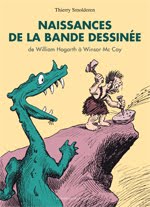
New Book: Naissances de la bande dessinée - De William Hogarth à Winsor McCay

This newly published book sounds fascinating! I've reproduced the English version of the book announcement below, but be sure to visit the book's official webpage for the French version, a peek at some pages, and a video narrated by Thierry Smolderen which includes lots of early comics.

Naissances de la bande dessinée
De William Hogarth à
Winsor McCay


Thierry Smolderen

24 x 33 cm / 144 pages
Nombreuses ill. en couleur
ISBN : 978-2-87449-082-8
EAN : 9782874490828
29,50 €

The Many Births of Comics

Around 1900 the American newspapers started publishing a new genre full of humour and action that we have no problems in identifying as the comics. And we also know that this comic strip appeared in the same years as the film and the phonograph. Yet what Thierry Smolderen convincingly demonstrates in this wonderful book is that the origins of this new genre are in fact much older, and that one can only understand the comic strip by linking it to the birth of a totally different genre, that of the modern novel, which appears in England during the the 18th Century. It was the satirical work of the painter and engraver William Hogarth that bridged the gap between image and novel and it was Hogarth who made a seminal contribution to a new narrative environment, enabling totally new forms of interaction between the image and the media of the modern era.

During the 19th Century, the new impulse given by Hogarth did not exceed the limits of a particular group of draughtsmen, the so-called humorist-illustrators who devote their immense visual culture to the mere goals of parody. Fascinated by the world of graffiti, children’s drawings and marginal productions, these artists were the very first to seize the opportunities given by the emerging media, schematized and combined by them in a spirit of irony. Since Rodolphe Töpffer, they also enjoyed themselves by criticizing the representations of the industrial world, which they questioned through their reuse of the naïve past of popular visual narratives. The comic strip will be the future emanation of these first experiments.

The Many Births of Comics proposes a new and fresh vision of what we thought we knew already. The book argues that instead of being a new medium that suddenly emerged at the turn of the century, the comic strip is indebted to a much older culture, that of the image to be read, a culture as old as that of the printed image. Seminal elements such as the speech balloon, the clear line and the visual storytelling are part of a genealogy that is much older and richer than event their authors themselves tended to believe. The initial dialogue of the comic strip with the experimental novel of the 18th Century as well as with the book culture of the romantic era, its long lasting cohabitation with the various kinds of illustrated press, its symbiosis with the world of the film, all these elements make the comics the potential workshop par excellence of today’s images.

Thierry Smolderen
Scriptwriter, theorist and Professor at the European School of Visual Arts, Thierry Smolderen is one of today’s top experts in the history of the comic. He has published numerous articles in French magazines (such as 9e Art) as well as American publications (such as Comic Art). The new theoretical foundations on which his research is based on have allowed him to reveal fascinating documents, which until now were unknown. Among his graphic novel plots, one can point out the imagined biography of McCay (illustrated by J-P. Bramanti, Delcourt publications), and the Ghost Money series (illustrated by D. Bertail, Dargaud publications).

Labels: , , , , ,


Wednesday, July 16, 2008

New Academic Journal: European Comic Art

European Comic Art is a new academic journal on comics, published by Liverpool UP. The journal's website describes it better than I can (especially since I haven't seen a copy yet):
European Comic Art will be the first English-language scholarly publication devoted to the study of European-language graphic novels, comic strips, comic books and caricature. Published in association with the American Bande Dessinée Society and the International Bande Dessinée Society, European Comic Art builds on existing scholarship in French-language comic art and will be able to draw on the scholarly activities undertaken by both organisations. However, our editorial board and consultative committee bring expertise on a wider European area of comic art production and the journal will emphasise coverage of work from across Europe, including Eastern Europe.
Given the contents of the first issue, including its roster of contributing scholars, this journal should become an essential resource. Get your library to order a subscription, pronto!
  • Introduction - Laurence Grove, Mark McKinney, Ann Miller, and Hugo Frey ... 0
  • Bande dessinee and the Cinematograph: Visual narrative in 1895 - Lance Rickman ... 1
  • De Luca and Hamlet: Thinking outside the box - Paul Gravett ... 21
  • Family History and Social History: Etienne Davodeau's reportage of reality in Les Mauvaises gens - Clare Tufts ... 37
  • Autobiographical Innovations: Edmond Baudoin's Eloge de la poussière - Matthew Screech ... 57
  • A Few Words about The System of Comics and More... - Thierry Groensteen ... 87
  • News and Reviews - edited by Hugo Frey ... 95
  • Artwork by Tanitoc
The first issue of European Comic Art is now available. For more information, see the journal's website.

Labels: , ,