Monday, September 23, 2013

CFP: Comics, Multimodality, and Composition / Special Issue of Composition Studies (Aug 1, 2014)

CFP for Special Issue of Composition Studies
Theme: Comics, Multimodality, and Composition
For 43.1 (Spring 2015)
Guest Editor: Dale Jacobs, University of Windsor

DESCRIPTION
Over the past ten years, composition has increasingly embraced writing and reading in multiple modes (words, but also images, sounds, video, spatial relationships, gestures, and other sign systems). In this movement towards multimodality, comics have been largely ignored. Comics, however, provide rich ground for exploration in relation to multimodality and composition. This special issue begins with the idea that comics are a valuable space of practice for multimodal literacies, both inside and outside the classroom.

Like other multimodal texts, comics form a multifaceted environment in which meaning is negotiated between creators and readers. Comics add another dimension to multimodality, which has often focused on digital texts, and can be used to link traditional alphabetic literacies with newer digital ones. Furthermore, as Michael Bitz argues in When Commas Meet Kryptonite: Classroom Lessons from the Comic Book Project, "In the context of new media and literacies, comics are a rare bridge between the canon of reading skills that children are expected to master in school and the literacies that they embrace on their own and out of school" (11). Not only are comics important multimodal texts in their own right, but they can also function as an important bridge to other literacies.

This special issue of Composition Studies will explore how comics can be productively used in writing theory and practice. Articles, sequential narratives, short reflective essays, and Course Designs are all welcome, as are pieces on comics aimed at the "Composing With" section of the journal. Possible topics include (but are not limited to):
  • Comics as a way to connect reading and composing multimodal texts.
  • Comics literacies and digital literacies.
  • Comics in relation to the NCTE Position Statement on Multimodal Literacies, the WPA Outcomes Statement, and/or the Framework for Success in Postsecondary Writing.
  • Comics and/as collaboration.
  • Comics, rhetoric, and the teaching of writing.
  • Comics theory and the teaching of writing.
  • Comics as a way to examine how students conceive and experience literacies outside of school and possible connections to school literacies.
  • Specific ways to use comics in the composition classroom.
  • Examinations of how Comics Studies can inform Composition Studies and vice versa.
TIMELINE
  • Full-length submissions due August 1, 2014
  • Submission determinations sent by November 1, 2014
  • Revised manuscripts due February 13, 2015
CONTACT
Direct queries about the special issue and full-length manuscripts in .doc or .docx formats to Dale Jacobs at djacobs@uwindsor.ca. Direct general questions about Composition Studies to compstudies@uc.edu. Visit our website for more information: http://www.uc.edu/journals/composition-studies.html.

Labels: , , , , , , , , ,


Monday, April 15, 2013

CFP: "Comic Theory" Book Collection (May 15)

As posted on the Comix Scholars list by Neil Cohn...
 
Call for Papers
"Comic Theory" Book Collection

While there have been a growing number of books on comics in recent years, very few have addressed aspects of structure, particularly from theoretical, cognitive, or experimental points of view and outside the realm of literary or sociocultural theory. I am working to organize a compilation of important papers on the understanding of sequential images. Most of the chapters will be either 1) summary papers that provide extensive bibliographies that can provide an overview to students and a resource to other researchers, or 2) reprints of significant research that remain under-recognized or hard-to-find.

This Call for Papers asks for proposals for papers of two types of chapters focused particularly on research outside of English, presented for an English speaking audience:

1. Chapters that summarize, in English, advances in comic theory from non-English speaking researchers. Such chapters should be large in scope with extensive reference sections.

2. Translations into English of significant non-English comic theory (structural, cognitive, experimental, etc.) from important papers or book chapters. (For example, from Gubern 1972, Fresnault-Dervelle 1972, Hünig 1974, Krafft 1978, Vidal 2004, etc)

Topics or chapters outside this scope may be considered, though best to contact me directly with inquiries: neilcohn@emaki.net. (Of interest may be: review papers of other types, historical development of comic “symbology”, grounded discussions of differences between comics cross-culturally, etc.)

Contributor Guidelines

1. Abstracts of 400-500 words accepted. Papers of 5000-9000 words, including notes and bibliography, accepted. Please also include a short biographical statement.

2. All documents should be submitted as Word or Word-compatible files. PDFs are also acceptable.

3. Submission deadline: May 15, 2013.

4. Materials should be sent to Neil Cohn via email: neilcohn@emaki.net

Labels: , , ,


Monday, September 24, 2012

CFPs (4): Comics at NEMLA (Sept. 30; Mar. 21-24)


Calls for Papers
44th Annual Convention
Northeast Modern Language Association
(NEMLA)
March 21 to 24, 2013
Boston, Massachusetts
Hosted by Tufts University


Panels and Pedagogy: Teaching the Graphic Novel
This panel works towards understanding and adding to emerging pedagogies of the graphic novel and other forms of illustrated works. What do these visual texts change about how we approach the classroom? Possible topics include but are not limited to adaptation and teaching across mediums and disciplines; the graphic novel as literature; approaches to visuality as composition; and the limits of genre and medium. Submit 250- to 500-word proposals by September 30, 2012, to Joel Simundich (joel_simundich@brown.edu) and Derek McGrath (derek.mcgrath@stonybrook.edu).

The Sequential Monster:  Reading Comics as Monstrous
Comic books, graphic novels and webcomics generally combine words and images to create narratives. Though comics are often considered a form in their own right, it is also possible to see them as an amalgam of disparate forms of communication. If we think of comics that way, perhaps we can see them, fruitfully, as monstrous: beasts that combine the elements of verbal and visual, narrative and static communication forms. This panel will examine a social understanding of the comics form (and the kinds of literacies required to accept it) using Scott McCloud’s and Will Eisner’s comics theories as well as Jeffrey Jerome Cohen’s monster theory. Abstracts of 300 words to lauere@sunysuffolk.edu by September 30.

Show and Tell: A Roundtable of Comic Book and Graphic Novel Creators
This event hosts artists from a wide spectrum of roles as related to the creation of comic books and graphic novels. This roundtable welcomes participants from around the world and regardless of genre, medium, or years of experience. Artists in the roundtable should bring visual materials to facilitate discussion with a diverse audience of students, professors, and overall fans of this art form. Submit resumes by September 30, 2012, to Derek McGrath at SUNY Stony Brook (derek.mcgrath@stonybrook.edu).

Comics Theory
This panel invites papers that explore comics theory. In what ways has comics theory evolved over the past twenty-five years? What are the current debates? In what ways have comics artists themselves shaped these debates? In what ways does American comics theory differ from comics theory that originated in France or Japan? In what ways have graphic narratives themselves taught readers how to understand the form? Please send completed papers or 300-word abstracts to Davida Pines at dpines@bu.edu. Deadline for proposals: Sep 30, 2012.

---

Conference information
44th Annual Convention
Northeast Modern Language Association (NEMLA)
March 21 to 24, 2013
Boston, Massachusetts
Hosted by Tufts University

The 2013 NEMLA convention continues the Association’s tradition of sharing innovative scholarship in an engaging and generative location. The 44th annual event will be held in historic Boston, Massachusetts, a city known for its national and maritime history, academic facilities and collections, vibrant art, theatre, and food scenes, and blend of architecture. The Convention, located centrally near Boston Commons and the Theatre District at the Hyatt Regency, will include keynote and guest speakers, literary readings, film screenings, tours and workshops.

Interested participants may submit abstracts to more than one NEMLA session; however, panelists can only present one paper (panel or seminar). Convention participants may present a paper at a panel and also present at a creative session or participate in a roundtable.  A/V requirements include a $10 handling fee to be paid with conference registration.
For more information on numerous panels, please visit the NEMLA call for papers web site (http://www.nemla.org/convention/2013/cfp.html).

Labels: , , , , , , ,


Friday, July 09, 2010

CFP: Comics Forum Leeds Art Gallery (Aug 16; Nov 18-19)

Comics Forum
18th and 19th November 2010

Women in Comics II
1030-1700, 18/11/2010

Following the success of ‘Women in Comics’ held at The University of Cambridge in 2009, and the significant support of both practitioners and academics, we are delighted to be holding a second ‘Women in Comics’ Conference.

The purpose of the conference is to provide analysis and insight into a field of culture that has traditionally been the domain of men. With an increasing number of female artists, writers, scholars and publishers of comics, this conference looks to celebrate women’s contribution to comics, and strengthen and investigate feminine perspectives within and surrounding comic art and narrative.

What are women creating within comics? How is female readership changing and evolving? What is the interface between women in comics and gender studies?

Our guest speaker is comic artist Suzy Varty who published the very first all-woman comic book in the UK in 1977.

Possible topics include but are not limited to:
  • Feminism and personal politics in comics
  • super-heroines
  • biographical and autobiographical comics
  • female comics authors/artists in history
  • manga
  • female characters
  • women in the alternative press
  • women in the comics industry
Suggestions for panels or individual presentations of 15 minutes are encouraged, and all genders are welcome to submit. Abstracts of 300 words should be submitted along with a short biography (100 words max.) to: Rikke Platz Cortsen rpc@hum.ku.dk and Catriona MacLeod c.macleod.1@research.gla.ac.uk. Please include the words ‘Women in Comics’ in your subject heading. Deadline for submissions is 16/8/2010.

Any general emails about the conference please email: Sarah Lightman s.lightman.1@research.gla.ac.uk


Theory and Practice:
A Conference on Comics
1030-1700, 19/11/2010

There are strong ties between the production and scholarship of comics, from the seminal works of Will Eisner in Comics and Sequential Art and Scott McCloud in Understanding Comics to the theoretically informed comics of Chris Ware (Jimmy Corrigan), Dan Clowes (Ghost World) and Seth (Wimbledon Green), among others. ‘Theory and Practice: A Conference on Comics’ will seek to investigate those ties, considering how comics both influence and are influenced by theoretical discourses of communication, aesthetics and narrative.

Subjects for discussion might include (but are not limited to):
  • The lives and works of comic creators who also theorise the form (or vice versa), e.g. Rodolphe Töpffer, Harry Morgan, Scott McCloud, Will Eisner, Benoît Peeters etc.
  • The roles played by theoretical discourse in the production of comics, or by the act of producing comics in the understanding of theory
  • The value of theory for practice and/or practice for theory in the field of comics
  • Understandings of comics that address the relative positions of the reader, the author, the artist etc. e.g. Philippe Marion’s discussion of the graphiateur
  • The concepts of breakdown and closure
  • Methodologies
  • The rise of practice-based research and its implications and/or applications for Comics Studies
Proposals of 250 words are invited for talks of 15-20 minutes in length, and should be emailed, along with a short biography (around 100 words) to Ian Hague (Department of History, University of Chichester) at I.Hague@chi.ac.uk.

Labels: , , , , ,


Friday, July 17, 2009

CFP: Critical Approaches to Teaching Graphic Narratives in the Literature Classroom (edited collection; 9/15/2009)

Thanks to ComicsResearch.org pal Dennis Gouws for the tip.
Friends from graduate school + Facebook = networking deluxe!


Critical Approaches to
Teaching Graphic Narratives
in the Literature Classroom


Deadlines: proposal by September 15, 2009; essay by December 15, 2009.

This edited collection is tentatively titled Critical Approaches to Teaching Graphic Narratives in the Literature Classroom. Commonly known as book-length comics, graphic narratives cover a broad range of topics and formats. The past three decades have seen an increase of readership of graphic narratives as well as scholarly interest in this subject. This collection brings together scholarly essays that discuss the challenges, methodologies, and strategies for using graphic narratives in both undergraduate and graduate classes. This volume hopes to fill in the gap between the texts and the classroom by providing a platform for scholars to discuss the connection between graphic narratives and other genres, themes, criticism, and theories. With scholarly essays from various disciplines as well as interdisciplinary fields this collection aims to promote discussion on critical approaches and pedagogical and methodological challenges facing instructors. Emphasizing a combination of practical and theoretical strength, this collection encourages dialogues among teacher-scholars, advances the new constellation of scholarship on the teaching graphic narratives, and provides students with useful references and critical approaches to analyzing particular texts as well.

Each chapter is between 6000 and 7000 words including notes and works cited (MLA format). Please send a 500-word proposal, a 2-page CV, and a paragraph of bio note by September 15, 2009. Essays are due by December 15, 2009. Please do not submit works that are under consideration elsewhere or have been published previously.

Send inquiries and proposals to:

Lan Dong
English Department, UHB 3050
University of Illinois
Springfield, IL 62703
Email: baerchendong@yahoo.com

Labels: , , , , , , ,


Thursday, July 16, 2009

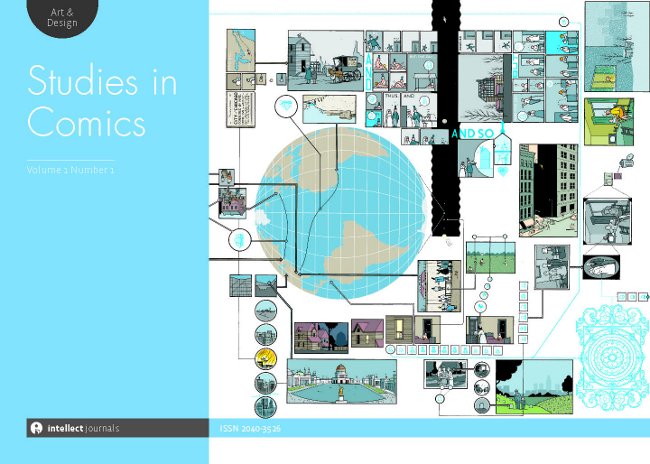
CFP: Studies in Comics (journal; September 1, 2009)

Last night we posted the initial announcement for the new journal Studies in Comics. Here's their first CFP.
Call for Papers

Papers are invited for Studies in Comics, a new international and interdisciplinary academic journal that aims to describe the nature of comics, to identify the medium as a distinct art form, and to address its formal properties. The inaugural edition will launch our investigations with a selection of world-class academic articles that explore the formal properties of comics, advancing their own theory of comics or responding to an established theoretical model. We also welcome reviews of new comics, scholarship, criticism and exhibitions, as well as unpublished creative work.

We are now inviting the following submissions:

Articles of 4,000-8,000 words from any discipline. These should have a strong critical focus and seek to apply hitherto unexplored theoretical approaches to the medium of comics or respond to published theories about the medium’s formal properties. Possible areas include:

  • Comics and visual language in the context of communications theory
  • The grammar of comics
  • Narrative structure
  • The relationship between panel, page, and the multiframe
  • Composition and panel transitions
  • The treatment of time and space
  • Responses to published theorists such as Scott McCloud, Will Eisner, Thierry Groensteen
We also welcome reviews of new publications and exhibits and short creative work of 1-5 pages in length. Creative work should be relevant to some aspect of comics, although there are no other thematic or stylistic restrictions. Metafictional submissions that deal with the processes and theories of comics creation are encouraged.

Please send all submissions to studiesincomics@googlemail.com.

Article submissions: please send 300 word abstracts and include the word ARTICLE in the subject heading. Submissions should be received by 1 September 2009 in the first instance. Please indicate the intended word count of the article. Completed papers will be required by 30 October 2009. All submissions will be peer reviewed. Papers must be submitted in English.

Reviews of publications and exhibitions: please include the words REVIEW PUBLICATION or REVIEW EXHIBITION in the subject heading.

Creative submissions: please include the word CREATIVE in the subject heading.

Reviews and creative work must be received by the same deadlines indicated above (1 September 2009 for statements of intention, 30 October 2009 for final work).

Submissions are welcome from both scholars and enthusiasts. Contributors are encouraged to approach comics from any discipline and to turn their attention to comics from all countries and in all languages. So whether you’re a semiotician, philosopher, scientist, historian, enthusiast, cultural, literary or film critic – Studies in Comics welcomes you!

Julia Round and Chris Murray (Editors)

M. Thomas Inge and Dean Chan (Associate Editors)
Paul Gravett (Review and Exhibitions Editor) and Roger Sabin (Consulting Editor)
Douglas Noble (Creative Submissions Editor)

Image credit: Cover to Studies in Comics, v1 no1, courtesy of editor Chris Murray. Artwork by Chris Ware.

Labels: , , , , , ,