Friday, September 19, 2014

CFP: Marvel Feature Films / essay collection (Nov. 15)

Call for Papers
Marvel Feature Films
edited by Robert Moses Peaslee,
Matt McEniry, and Robert G. Weiner

The recent release of Guardians of the Galaxy marks the penultimate film in the so-called second “phase” of the Marvel Cinematic Universe, a group of big-budget tentpole films that include Marvel’s The Avengers, Captain America: The Winter Solider, Thor: Dark World, Iron Man 1-3, and the Incredible Hulk. Meanwhile, other studios like Sony and Fox have had success with films based on Marvel properties such as the X-Men and Spider-Man.

Feature films and full-length television movies based on Marvel characters go back to the 1970s, however, and very little scholarship has been produced on these films. The editors of this volume seek essays that discuss Marvel feature length films, and while we will consider essays that deal with the Marvel Cinematic Universe and more recent films, we are particularly interested in those films that have not received a lot of scholarly attention (including television and animated features).  We are also interested in work dealing with films produced when certain characters were Marvel properties (like Transformers, G. I. Joe, and Conan). Please note we are not interested in television series, per se, but rather the full-length films produced from them. We are also interested in the business aspect of Marvel Films and Marvel Animation.  We will also consider essays on those unauthorized foreign films based on Marvel characters like Turkish Captain America/Spider-Man, etc.

We are particularly interested in considering essays dealing with:
Transformers (1986), G.I. Joe (1987), Howard the Duck (1986), Captain America  (1979, 1990), Inhumanoids: the Movie (1986),  Trial of the Incredible Hulk (1989), Man-Thing (2005), Ghost Rider (2007, 2011), Spider-Man: The Dragon’s Challenge (1979), Dr. Strange (1979), Generation X (1996), Power Pack (1991), Punisher (1989), Nick Fury: Agent of Shield (1998), Blade 1-3 (1998, 2002, 2004), Elektra (2005), Thor: Tales of Asgard (2011), Iron Man: Rise of Technovore (2013), Planet Hulk (2010), Fantastic Four (1994) and Next Avengers (2008).

A brief but by no means conclusive list of interesting questions to consider:

  • How has Disney’s acquisition of Marvel changed the blockbuster landscape?
  • Why were certain television or direct to video films like Captain America (1990), Captain America: Death Too Soon or Spider-Man: The Dragon’s Challenge released theatrically overseas?
  • Why did Howard the Duck fail to live up to its hype, and what are we to make of his recent reappearance in the CMU?
  • How can we think more deeply about the use of legend and myth in these films?
  • What was the production history of Transformers (1986) and how did the film eventually factor into the continuity of the Marvel comics series? 
  • Cyberpunk influences, particularly in films like Iron Man: Rise of Technovore
  • Faustian influences in the Ghost Rider films and the use of the original Ghost Rider, Carter Slade, in the first film.
  • How Daredevil and Thor were used in the Hulk television films?
  • While Blade was moderately successfully in 1998, why did it take the 2000’s X-Men to kick start the current wave of Marvel and superhero films?
  • Generation X as an example of X-film?
  • Has Marvel Animation been successful compared to DC in producing high quality animated films?
  • Planet Hulk as Greek/Roman myth?
  • Traditional vampire lore in the Blade series.
  • Spider-Man as a villain in the Turkish 3 Dev Adam, also featuring Captain America.
  • The Bollywood 'Tu Mera Superman featuring a mash-up of Superman and Spider-Woman?
  • Production history of producer Roger Corman’s ill-fated attempt at the $2 million Fantastic Four film.

Please submit a 200-500 word abstract by November 15th to Rob.weiner@ttu.edu and Matthew.mceniry@ttu.edu

Upon acceptance final essays will be due on Feb 15th.

Labels: , , , , , , ,


Friday, May 23, 2014

CFP: The Ages of the Incredible Hulk / essay collection (July 15)

CFP:
The Ages of
the Incredible Hulk
Edited by Joseph J. Darowski
Publisher: McFarland & Company

The editor of The Ages of the Incredible Hulk: Essays on Marvel’s Jade Giant in Changing Times is seeking abstracts for essays which could be included in the upcoming collection. The essays should examine the relationships between Incredible Hulk comic books (or comic books featuring Hulk-related characters) and the social era when those comics were published. Analysis may demonstrate how the stories found in Hulk comic books and the creators who produced the comics embrace, reflect, or critique aspects of their contemporary culture. This will be a companion volume to The Ages of Superman, The Ages of Wonder Woman, The Ages of the X-Men, The Ages of the Avengers, and The Ages of Iron Man.

Potential chapters include, but are not limited to, the following:

Controlling the Bomb: A Scientist’s Unintended Consequences in The Incredible Hulk; Nuclear Power, the U.S. Military, and Fear: The Weaponization of Bruce Banner; Balance of Power: The Hulk’s Awkward Role in The Avengers; The Hulk Versus the U.S. Military in the Vietnam War Era; The Two Sides of Nuclear Power: Bruce Banner and Samuel Sterns; Hulk Versus the Abomination: Cold War Politics in Superhero Adventures; She-Hulk and the Working Woman; The Incredible Hulk: Crossroads and the Search for Identity; Raising Awareness of Child Abuse in Marvel Comics and a New Origin for the Hulk; Future Imperfect: Unchecked Power After the Cold War; Addressing AIDS in Marvel Comics: Jim Wilson, Rick Jones, and the Hulk; The Sensational She-Hulk and Hyper-Awareness of Contemporary Comics; Hulk: The End and Dystopian Fears in the New Millenium; Twenty-First Century Gladiator: Planet Hulk; Red Hulk: Becoming What You Fear.

Essays should focus on stories from the Hulk’s comic book adventures, not media adaptations of the character. Furthermore, essays should look at a single period of comic book history, rather than drawing comparisons between different publication eras. For example, an essay that analyzed Hulk comics from the early 1960s and contextualized them with what was happening in American society would be more likely to be accepted than an essay that contrasted Hulk comic books from the 1970s with Hulk comic books from the 1990s. Any team title or mini-series that features Hulk, or Hulk-related characters such as She-Hulk, Red Hulk, or Skarr, can be considered as source material for potential chapters. The completed essays should be approximately 15-20 double-spaced pages.

Abstracts (100-500 words) and CVs should be submitted by July 15, 2014.

Please submit via email to Joseph Darowski, darowskij@byui.edu

Labels: , , , ,


Monday, April 15, 2013

CFP: The Ages of Iron Man / Essay Collection (July 15, 2013)

CFP - Collection:
The Ages of Iron Man:
Essays on the Armored Avenger in Changing Times
Edited by Joseph J. Darowski
Publisher: McFarland & Company

The editor of The Ages of Iron Man: Essays on the Armored Avenger in Changing Times is seeking abstracts for essays which could be included in the upcoming collection. The essays should examine the relationships between Iron Man comic books and the period of American history when those comics were published. Analysis may demonstrate how the stories found in Iron Man comic books (and the creators who produced the comics) embrace, reflect, or critique aspects of their contemporary culture. This will be a companion volume to The Ages of Superman, The Ages of Wonder Woman, The Ages of the X-Men, and The Ages of the Avengers.

Essays should focus on stories from Iron Man’s comic book adventures, not media adaptations of the character. Furthermore, essays should look at a single period of comic book history, rather than drawing comparisons between different publication eras. For example, an essay that analyzed Iron Man comics from the early 1960s and contextualized them with what was happening in American society would be more likely to be accepted than an essay that contrasted Iron Man comic books from the 1970s with Iron Man comic books from the 1990s. Any team title or mini-series that features Iron Man prominently can be considered as source material for potential chapters. The completed essays should be approximately15 double-spaced pages.

Some possible topics for essays include, but are not limited to, the following:
  • An Entitled, Womanizing, Weapons Designer is Our Hero?
  • A Viet Nam War Superhero: Tony Stark, Industrialists, and the Cold War
  • Communism and The American Superhero: Tony Stark’s Early Adventures
  • The Mandarin: Cold War Stereotypes, and Supervillains
  • "The Demon in a Bottle" and Social Relevancy in Superhero Comic Books
  • Race Under the Armor: When James Rhodes Was Iron Man
  • "Doomquest": The Changing Meaning of Heroism
  • Armor Wars: Weapon Proliferation and Deterrence
  • From Iron Man to War Machine: Rhodes’ Journey to Hero
  • Force Works and a New Vision of Defense 
  • Earth X Iron Man: Tony Stark as Millennial Doomsday Prepper
  • "The Best Defense": Superhero Politics and the Aggressive Defense of America
  • "Extremis" and the Biological/Technological Hybrid
  • Marvel’s Civil War: Iron Man’s Quest to Control Potential Threats Post 9/11
  • Iron Man – Director of Shield: A Weapons Engineer Leading the Military Industrial Complex
  • Gender and Iron Man: Pepper Potts as Rescue
Abstracts (100-500 words) and CVs should be submitted by July 15, 2013. Please submit via email to Joseph Darowski, darowskij@byui.edu

Labels: , , , , ,


Wednesday, September 05, 2012

CFP: The Ages of the Avengers (collection; Jan. 15)

CFP - Collection:
The Ages of the Avengers:
Essays on the Earth’s Mightiest Heroes
in Changing Times
Edited by Joseph J. Darowski
Publisher: McFarland & Company

The editor of The Ages of the Avengers: Essays on the Earth’s Mightiest Heroes in Changing Times is seeking abstracts for essays which could potentially be included in the upcoming collection. The essays should examine the relationships between Avengers comic books and the period of American history when those comics were published. Analysis may demonstrate how the stories found in Avengers comic books (and the creators who produced the comics) embrace, reflect, or critique aspects of their contemporary culture.

Essays should focus on stories from the Avengers’ comic book adventures, not media adaptations of the character. Furthermore, essays should look at a single period of comic book history, rather than drawing comparisons between different publication eras. For example, an essay that analyzed Avengers comics from the early 1960s and contextualized them with what was happening in American society would be more likely to be accepted than an essay that contrasted Avengers comic books from the 1970s with Avengers comic books from the 1990s. Any of the spin-off Avengers titles or mini-series that focus on teams (West Coast Avengers, Young Avengers, Mighty Avengers) can be considered, but solo titles that feature members of the Avengers (Iron Man, Captain America, Thor)should not be used as the primary focus of an essay. The completed essays should be 12-15 double-spaced pages.

Some possible topics for essays include, but are not limited to, the following:

“Captain America Joins…the Avengers”: The World War II Hero Encounters a New Generation of Americans; The Kree/Skrull War: Conspiracies, Government Agencies, and Public Protests; The Avengers/Defenders War: Just What Are We Fighting this War for Anyway?; Korvac Saga: Gods, Religion, and Faith on the Comic Book Page; Affirmative Action and Tokenism: Falcon Takes a Stand by Leaving the Avengers; Race and Gender Issues on Superhero Teams: Captain Marvel and Team Leadership; “The War on Olympus” and Guilt for Collateral Damage; “Operation: Galactic Storm” and Proactive Versus Reactive Philosophies to Potential Threats; Avengers Forever: Questions of Time, History, and Meaning at the Turn of the Century; “Ultron Unlimited” and the Fear of Evolving Technology; “Red Zone”: Hidden Threats Right in Front of Our Eyes; The Ultimates: Fashioning Earth’s Mightiest Heroes for a New Millenium; “Breakout”: Rebooting a Franchise for Blockbuster Audiences; Young Avengers and Avengers Academy: Addressing Homosexuality in Superhero Comic Books; The Uncivil Debate Within of Marvel’s Civil War; Dark Avengers: Are There Good Guys Anymore?

Abstracts (100-500 words) and CVs should be submitted by January 15, 2013
Please submit via email to Joseph Darowski, darowskij@byui.edu

Labels: , , , , ,


Saturday, February 12, 2011

CFP: The Material History of Spider-Man (MLA) (Mar. 5; Jan 5-8)

CFP: The Material History of Spider-Man:
A 50th Anniversary Observance

Call for Papers for a panel at the Modern Language Association (MLA) Annual Convention, 5-8 Jan. 2012, Seattle. This panel will be sponsored by the MLA Discussion Group on Comics and Graphic Narratives (http://graphicnarratives.org)


To commemorate the 50th anniversary of Spider-Man’s first appearance in Amazing Fantasy #15, this session seeks to examine the histories imbricated in this iconic figure. From his Cold War origins in 1962, to his emergence as a symbol of the counterculture, to his commemoration of indelible moments in 21st-century America (e.g., Amazing Spider-Man #477—the 9/11 issue, or Amazing Spider-Man #583—the Obama issue), Spider-Man’s continuing narrative traces/haunts/aligns with US cultural history in provocative ways. This session seeks to understand what is revealed when one follows these relationships through the proliferation of texts — dozens of different comic book series, several television shows, a number of young adult novels, multiple films and videogames, and myriad other adaptations, including a pending Broadway musical — produced over the fifty-year development of this American icon.

Possible areas of inquiry may include, but are certainly not limited to:
  • Cold War technology and the origins of Spider-ManThe liberal consensus and the masked hero
  • Spider-Man and the counterculture
  • Archives and artifacts: Spider-man and the multimedia trace
  • Spider-Man on campus
  • The various Spider-Man comic books as barometers of contemporary culture
  • Spider-Man and 9/11
  • The “Civil War” crossover series and the War on Terror
  • The cultural significance of Spider-Man adapted into other media
  • Spider-Man in the age of Obama
Send 500-word abstracts in .doc or .pdf form to Derek Royal: derek at derekroyal-dot-com. The deadline for submissions is 5 March 2011. Submitters will receive notification of results by no later than April 1.

Please note that all prospective presenters must be current MLA members by no later than 7 April 2011.

This CFP can also be viewed at the website for the MLA Discussion Group on Comics and Graphic Narratives (http://graphicnarratives.org).

Labels: , , , , ,


Sunday, January 16, 2011

Tales from the Green Scrapbook #5: TV Guide on Spider-Man Special Effects

Being another in our occasional series of scans of items I taped into a green notebook when I was a child...

Journey with me back to 1978. A simpler time than now, when television signals traveled through the airwaves, not cables, but when cables were high-tech special effects gear. Journey, then, to a location shot for The Amazing Spider-Man television show: The Empire State Building, and view the death-defying harness work of Spider-double Fred Waugh. That's right, kids; no green screens or digital compositing. Just a man, a building, and a harness that must have chafed like the dickens. Now that is a special effect.
Source: This time I've got it! TV Guide, September 2, 1978.

Labels: , , , , ,


Sunday, January 09, 2011

Tales from the Green Scrapbook #4: Conan the Barbarian Newspaper Strip

Being another in our ridiculously occasional series of scans of items I taped into a green notebook when I was a child...

I was never the world's biggest fan of Conan, either the comics or the original novels. But in September of 1978, when the Conan the Barbarian newspaper comic strip debuted in the Milwaukee Journal (and many other newspapers across the land), I dutifully fulfilled my comic-book-nerd duty and saved the article announcing the strip for posterity.

Not being a huge fan, I consequently don't have too much to say about the article now. It reads mostly well to me today, a switch from some of the previous entries I've posted here under the "Tales from the Green Scrapbook" rubric. It hits the high points I knew about, and it hypes Roy Thomas' writing and, to a lesser extent, Jon Buscema's artwork, to the proper degrees.

So all that's left for me to do is to apologize for (1) not noting the actual publication date when the article was published, and (2) cramming things together and making it all so hard to read. Still, I hope you enjoy it for what it is, a time capsule into a bygone era when an adventure comic strip could be launched in the newspapers and have the faintest hope of being popular. (Not that Conan particularly was all that popular as a strip; I'm not sure how long it lasted, but it couldn't have been for too long.)

Labels: , , ,


Monday, August 31, 2009

Disney to Buy Marvel Comics for $4 Billion

I checked the calendar, and it's not April 1...
Disney to Buy Marvel Comics for $4 Billion
By THE NEW YORK TIMES
Published: August 31, 2009

The Walt Disney Company said Monday that it would buy the comic book giant Marvel Entertainment for about $4 billion.
[...]
With the acquisition, Disney will acquire more than 5,000 Marvel characters, including Spider-Man, Iron Man, Captain America, Hulk and the X-men.
I suppose we need to brace ourselves for "Spider-Mickey," "Minne Mutant," "Wolverduck," the "X-Muppets," and "Purple Pluto."

Read the entire story at the New York Times website.

Tip of the hat to Mike "ComicsDC" Rhode!

Labels: , ,


Wednesday, August 19, 2009

Assembled! 2: Earth's Mightiest Heroes and Villains

Here's the press release for a new book on the Marvel Comics super-team The Avengers, edited by "Friend of the Blog" Van Allen Plexico. ASSEMBLED! 2
Earth’s Mightiest Heroes and Villains

The Jarvis Heads are back with another humorous and insightful look at Marvel Comics’ Avengers and their foes in ASSEMBLED! 2 – Earth’s Mightiest Heroes and Villains.

Sequel to the very successful ASSEMBLED! and an intensive examination of all things Avengers, this book focuses on the "Big Three"-- Thor, Iron Man, and Captain America-- plus the "Big Two" villains, Ultron and Kang! What makes each of them tick? How have their relationships toward one another evolved over the years, through events such as the Kree-Skrull War or Civil War? What might become of the Big Three in the future?

Additional chapters look at the recent IRON MAN movie plus YOUNG AVENGERS, AVENGERS FOREVER and more. And to top it all off, Marvel Executive Editor Tom Brevoort supplies a fascinating and quite surprising introduction.

The Jarvis Heads combine insightful analysis with humor and sometimes surprising opinions for a total package that will both inform and entertain—and the profits go to the HERO Initiative charity for retired comics pros!

Written by the Jarvis Heads of AvengersAssemble.net, created and edited by Van Allen Plexico, and with an introduction by Marvel Comics Executive Editor Tom Brevoort.

Cover by Anthony Schiavino
Book design by Danny Wall
Asst. Editor Joe Crowe.

Diamond Previews order number:
SEP091067 ASSEMBLED 2 GT EARTHS MIGHTIEST HEROES & FOES SC

A White Rocket Book. For more information, visit http://www.whiterocketbooks.com

Labels: , ,


Saturday, August 08, 2009

Now We Are (Not) Six

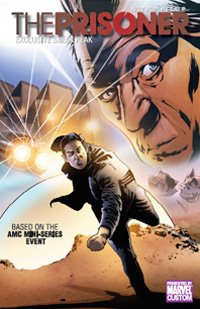
I'd heard, and considered with no little trepidation, that a new version of "The Prisoner" would debut later this year on the AMC channel. The reason for my trepidation: I am a huge fan of the enigmatic original series, created by and starring Patrick ("Danger Man" / "Secret Agent") McGoohan. In the new version, Jim (Jesus) Caviezel stars as “Six” (no more “Number”), with “Two” played by Ian (Magneto) McKellan.

Sure, some parts might appear a little too kitschy or mod by today's standards, but the series -- concerning a secret agent (man?) who retires, only to wake up in an incomprehensible apparent utopia called "The Village" -- is a riveting thirteen-episode examination of intrigue, intensity, and nigh-intolerable suspense.

Questions abound: Why is everyone referred to only by number not name, and why is the main character referred to as "Number Six"? Which side (or what?) do the succession of "Number Twos" work for, as they attempt again and again to break Number Six's spirit in order to discover why he resigned? Will Six ultimately succumb, or will he endure and discover the identity of the never-seen "Number One"? How on earth did McGoohan get the rights to The Beatles' "All You Need Is Love" for the final episode?

We pause now for this message from The Times:

Now, back to our show:

The final two episodes, btw, are perhaps the most riveting 90mins of television I ever have seen. And that final episode is brilliant, both meeting and disappointing viewers' expectations.


But what does this have to do with comic? Not having gone to the San Diego Comic Con myself, I didn't hear about Marvel Comics' tie-in book until today. AMC has a copy of the eight-pager (no, not that kind) available as a PDF for download. As are most teasers of this sort, it's short on plot, but it sets that stage pretty well for what's to come. Yes, there seem to have been some changes, but from the little we see here, so far there's nothing to make me apoplectic. But time -- if not Two -- will tell.

Be seeing you.

Labels: , , ,


Wednesday, October 29, 2008

Be a Library Intern at Marvel Comics

If I lived near New York city, were enrolled in an MLIS program, and 20 years younger, I would jump at this opportunity...
Library & Inventory Intern
Marvel Entertainment, Inc

Marvel Entertainment, Inc. is looking for MLIS students interested in an internship for school credit. Potential candidates must be local to or able to commute to New York City. Interested candidates should apply online:
http://www.marvel.com/company/webinterns.htm?concentration=inventory

Purpose of Position
The purpose of this position is to assist with the inventory, the re-organization, and the cataloging of items in Marvel's library. The Library & Inventory Intern will be responsible for completing inventory of books and mixed media against data in a database and manually cataloging books for which no data exists. Cataloged items will be re-organized in the library according to the standards agreed upon by the Publishing Department and the Archivist. This position requires great attention to detail, superior organizational skills, ability to work independently with little supervision and the ability to lift 30-40 pounds. This internship is within the Publishing Department and is unpaid, but qualifies for school credit.

Responsibilities
1. Complete library inventory and catalog
  • Scan UPC codes and match to Oracle data to add quantity to inventory
  • Search titles/ISBN for books without UPC codes for a match and add quantity to inventory
  • Manually catalog books without pre-existing data
2. Reorganization of library
  • Weed any material that does not comply with retention standards
  • Shelve books according to established standards and record location
Qualifications
Candidates must have the following experience or qualifications:
  • Enrollment in a Library Science program
  • An interest in cataloging and special collections
  • Knowledge of Microsoft Excel and Microsoft Access
  • Must be able to work independently with little supervision
  • Must be organized, analytical, and reliable
  • Must be accurate and able to ensure data integrity

Labels: , , ,


Monday, March 20, 2006

Marvel & DC's Super-Hero "Claim"

As BoingBoing notes (also here, with earlier info here), Marvel Comics is again flexing its muscles and asserting that it co-owns (with DC Comics) a trademark on the term "super heroes" - this time in the publicity for its "Marvel Super Heroes Science Exhibition."

Marvel and DC have been claiming and attempting to enforce this "trademark" for many years. According to this link (one of several) from the US Patent and Trademark Office's "Trademark Application and Registration Retrieval system," Marvel & DC claim a "First Use in Commerce Date" of October 1966. Most knowledgeable folks aggree that this claim is bogus on many levels, but that hasn't stopped the USPTO from allowing the publishers to register the claim successfully and repeatedly over the past few decades. Digging around the archives via TESS reveals that all TM claims aren't automatically registered - some are denied. But from what I can tell, they've never denied Marvel & DC's claim.

Apparently, just because the USPTO allows you to register a trademark doesn't actually mean that they're endorsing your claim's validity - they're just aggreeing that, well, you've made the claim (tax dollars at "work," folks!). I suppose if someone with deep enough pockets and stamina to spare were to take Marvel & DC to court over this, the claim's bogus nature would be revealed and overcome. But until then, these two "super-gorillas" continue to throw their imagined weight around.

Thanks to several folks at the Comics Scholars Discussion List for helping me figure out what I think is going on in this situation. Caveat lector: I ain't no lawyer!

Labels: , , , ,