Tuesday, February 18, 2014

CFP: 2014 AX Anime and Manga Studies Symposium (May 1; July 3-6)

Call for Papers / Call for Speakers
2014 AX Anime and Manga Studies Symposium
July 3 - July 6
Anime Expo 2014

Los Angeles Convention Center (Los Angeles, CA)

www.anime-expo.org
Keynote Speaker:
Prof. Marc Steinberg (Concordia University, Montreal, Canada)
Submission Deadline: May 1, 2014

Japanese animation (anime) and comics (manga) represent one of the major contributions that Japan has made to global visual and popular culture. Indeed, for many people, their first - and sometimes only - contact with Japanese culture at all is through Japanese visual culture.

The field of anime and manga studies is young, only about 30 year old, but extraordinarily vibrant.
It welcomes a wide range of interpretations and approaches, draws on different disciplines and methodologies, and can involve both academics, industry professionals, independent scholars, and fans/enthusiasts.

A major goal of the Anime and Manga Studies Symposium is to bring together speakers from diverse backgrounds, fields and areas to exchange ideas, explore new directions, and contribute to building a community of anime and manga studies. Uniquely, the Anime and Manga Symposium is an integral part of the schedule of Anime Expo, the largest gathering of fans of Japanese popular culture in the U.S. This will give speakers an opportunity to present their research and scholarship directly to public, non-academic audience, to interact with fans of anime and manga from around the world, and to becomeparticipants in a celebration and appreciation of Japanese popular culture. In turn, the Symposium also serves to introduce convention attendees to the ideas and practices of formal scholarship of Japanesevisual culture.

Submissions on a wide range of topics dealing with anime and manga will be considered. Possible areas to explore can include—but are not limited to:
  • Critical studies of individual creators, directors and animators, especially in larger contexts such as anime/manga as a whole, animation, comics, Japanese literature/film, science fiction, war literature, etc.
  • Close readings of particular works, with a focus on genre conventions and subversions and relationships to previous works in anime/manga and other media.
  • Gender and Sexuality: Fan service and objectification, the male and female gaze, the interplay of male and female creators, producers, and audiences
  • Age, class, race, ethnicity/nationality and other social differences
  • Reflections on current social, political and ecological issues
  • Responses to the world and to Japanese history: The 3.11 Tohoku Disaster, World War II, interactions between Japan and other countries
  • The impact of new technologies (wireless communication, augmented reality, mobile computing) on storytelling in anime/manga
  • The use of remix culture: Adaptation and interpretation of Eastern, Western and other literatures and visual media in Japanese popular culture
  • Copyright, obscenity, and other legal issues
  • Anime and manga as tools of globalization and agents of promoting Japanese culture
  • The history and evolution of anime/manga fandom outside Japan: Fan practices and experiences—clubs, conventions, cosplay, fansites, fansubbing, anime music videos
  • The future of anime/manga consumption – streaming, online comics, crowdsourcing, etc.
  • Potentials for anime/manga as platforms for social change and anime/manga fans as actors of social change
  • The ethics and challenges of presenting Japanese popular culture products around the world
The Symposium particularly welcomes presentations on newer/emerging works and creators.

Speakers are also welcome to submit proposals for roundtable discussions on these and related topics.

Potential roundtables can include:
  • Differences in theoretical approaches to anime and manga
  • Anime/manga fan practices and activities in different countries, cultures and regions
  • New directions, new opportunities, and new challenges in thinking, writing, and teaching about anime/manga
The AX Anime and Manga Studies Symposium will be open to all AX attendees. Speakers are urged to consider subjects that will be of interest to general non-specialist audiences and do not require significant backgrounds in Asian Studies, media theory, literature, etc.

For consideration, please submit the title of your paper or panel, an abstract (300 words maximum) and a CV to mkoulikov@gmail.com

DEADLINE FOR SUBMISSIONS: May 1, 2014

All submissions will be peer-reviewed.

All invited participants will be offered free admission to Anime Expo.

Labels: , , , , , ,


Wednesday, May 29, 2013

CFP: Global Manga: The Cultural Production of Japanese Comics outside Japan (collection; Aug. 31)

As posted on amrc-l.

Call for Book Chapters:
Global Manga:
The Cultural Production of
Japanese Comics outside Japan

According to Wikipedia, "'manga' as a term used outside Japan refers specifically to comics originally published in Japan." Yet careful inspection of the Manga section of any chain bookstore in the English-speaking world quickly reveals that the books on the shelf are not exclusively comics originally published in Japan. Svetlana Chmakova's Nightschool sits alongside Masashi Kishimoto's Naruto, the Soulless adaptation alongside Soul Eater. And beyond the Manga section proper, there abound comics and graphic novels published within the last decade or so whose very existence is possible only in cultural and economic contexts rich with Japanese comics in translation, such as Scott Pilgrim, Megatokyo, and Yen Press's Twilight graphic novels.

There is no one universally agreed-on name for these works; appellations include OEL manga, world manga, Amerimanga, international manga, and—the term used here—global manga. Some would dismiss global manga as "fake manga," as pale imitations of their Japanese counterparts, as unworthy of attention from readers, let alone researchers. This book aims, however, to take seriously the political economy and cultural production of these Japanese comics outside Japan.

The phrase "Japanese comics outside Japan" does not merely suggest manga published in translation or manga materially exported from Japan. At its most radical, it suggests, rather, manga without Japan. There is a sometimes globalized, sometimes transnational, and sometimes hyperlocal world in which manga can be produced without any direct creative input at all from Japan. And if something called "manga" that is not in any strict sense Japanese can be published, there are a number of important questions to be asked: What do these fields of cultural production look like? Why and under what sorts of conditions do they arise and flourish? Who gets to decide what counts as "manga," and who benefits from that decision? What are global manga's implications for contemporary economies of cultural and creative labor? And finally—perhaps most important of all—what does it mean, therefore, for manga to be "authentically" Japanese?

This anthology takes the problematic of what it means to have manga without direct Japanese involvement as its focus. Chapters addressing the theme of global manga outlined in the previous paragraphs are solicited, with a view toward the publication of a multi-authored volume consisting of between 10-12 chapters. A commissioning editor from a well-known academic press has expressed preliminary interest in this project.

Possible topics include (but are not limited to):
  • OEL manga, GloBL manga, amerimanga, manhwa, and/or manhua creation/publishing
  • local manga production in Korea, France, China, Indonesia, Germany, or other national territories
  • single title case studies
  • amateur manga/doujinshi publishing outside Japan
  • theoretical analyses of "real" versus "fake" manga 
  • first-person historical overviews/reflective essays by industry insiders
  • the production of transmedia tie-in manga
SUBMISSION PROCEDURE:

Chapter proposals from authors with both academic and industry/practitioner backgrounds are welcome. Prospective contributors should submit 1) an extended abstract of 450-500 words, 2) an indicative bibliography, and 3) a short biographical sketch no later than August 31, 2013.
The deadline for full manuscripts of 5000-7000 words will be three months from notification of acceptance.

Please direct any inquiries and submissions to Casey Brienza, City University London (casey.brienza.1@city.ac.uk).

Labels: , , , ,


Wednesday, November 21, 2012

CFP: Comics, Picturebooks and Childhood [journal issue] (March 31)

CFP:
Comics, Picturebooks and Childhood
Special issue of the
Journal of Graphic Novels and Comics
 
Special Issue Editors: 
Dr. Mel Gibson (University of Northumbria)
Dr. Kay Sambell (University of Northumbria)
Dr. Golnar Nabizadeh (The University of Western Australia)

This special edition will explore links between these two media in relation to childhood. Both have been studied in relation to how they work (key examples being Maria Nikoljeva and Carole Scott (2001) How Picturebooks Work and Thierry Groensteen (2007) The System of Comics). The history, specific creators, culture and audiences for these media have also been areas of research. Focusing on the links across illustration, graphic narratives and visual culture, this special issue offers critical interventions on the field of comics and picturebooks.

They are not typically considered together, although some research has done so, for example Mel Gibson (2010) 'Graphic Novels, Comics and Picturebooks' in David Rudd (ed) Routledge Companion to Children's Literature (pp.100-111) and David Lewis (1998) ‘Oops!: Colin McNaughton and “Knowingness”’ in Children’s Literature in Education, 29 (2), pp. 59-68.

In relation to audience (a focus in Lewis, above), comics and picturebooks have frequently been associated with younger readers, despite the two being very flexible media which can be used to address readers of all ages on any topic. When such assumptions are dominant, this is usually related to perceptions of what might be ‘appropriate’ content.

Sometimes controversy is about an entire medium as outlined by John A. Lent (1999), in ‘Comics Controversies and Codes: Reverberations in Asia’ This chapter in Pulp Demons: International Dimensions of the Postwar Anti-Comics Campaign flagged up ways in manga were seen as having an impact upon the health and morals of young people in South Korea, Japan, the Philippines and Taiwan between the 1940s and the 1980s (pp179-214).

Equally, controversy might focus on a single text, as was the case in relation to the British publication of Jenny lives with Eric and Martin by Suzanne Bösche (originally published in Denmark as Mette bor hos Morten og Erik), one of the first picturebooks focusing on homosexuality and family structure. This single text was a key element in Britain in the introduction of the Section 28 of the Local Government Act 1988 which forbade the ‘promotion’ of homosexuality by local government.

In both these cases, what may be seen to underpin controversy relating to these media are social constructions of childhood, a concept developed within Childhood Studies and perhaps best illustrated by Allison James and Alan Prout (eds.) (1990) Constructing and Reconstructing Childhood.

This issue also constitutes an attempt to extend the scope of scholarship on the comic and the picturebook beyond US/UK and European critical frameworks by highlighting Asian and Australian visual cultures and contexts.

Proposals are sought on, but not limited to the following;
  • Creators who work with both these media, such as Raymond Briggs and Shaun Tan.
  • Picturebook creators who are influenced by comics. For example, the ways in which the work of Maurice Sendak is influenced by that of Winsor McCay
  • Comics for children and constructions of childhood
  • Controversies around comics, picturebooks, childhood and child readers
  • Defining the borders and emerging areas in comic book scholarship
  • Manga, comics and picturebooks
  • Comic book conventions and avant-garde innovations
  • Divergences and intersections between comic books and picturebooks
  • When and how does a comic book creator become perceived as a picture book creator?
  • In what ways do constructions of childhood as innocent and vulnerable impact upon what is considered suitable content in a comic or a picture book?
Deadline for proposals for 5000-7000 word articles is March 31st 2013 (for issue 5:1, June/July 2014 of the Journal of Graphic Novels and Comics http://www.tandfonline.com/toc/rcom20/current). Send proposals to Dr Mel Gibson at mel.gibson@northumbria.ac.uk

Labels: , , , , , , , , , , ,


Saturday, November 17, 2012

CFP: Anime and Manga [PCA/ACA, Washington D.C.] (Nov. 30; Mar. 27-30)

CFP:
Anime and Manga
PCA/ACA 2013 National Conference
Washington D.C.
March 27-30, 2013

This is the national meeting of the Popular Culture Association and the American Culture Association. This submission is under the area “Asian Popular Culture.” There are two “Calls for Papers.”  

Deadline: November 30, 2012

Submissions should be submitted online. Instructions can be found here: http://pcaaca.org/national-conference-2/proposing-a-presentation-at-the-conference/

In addition, please submit your proposal to Wendy Goldberg (wdgoldbe@olemiss.edu), who will organize these panels.

CFP: The “Abject” in Anime and Manga

This call is for papers that focus on the “abject” in anime and manga. French theorist, Julia Kristeva, in her essay, “Powers of Horror,” defines the abject as that which threatens the boundary between subject and object, producing fear and revulsion.  The classic “abject” example would be the corpse which is like/unlike a living body.

Papers may not necessarily deal directly with Kristeva’s theories but participants are encouraged to explore the use of the horrific or the grotesque in anime and manga. Papers may explore how the abject comment on social or political institutions in addition to individual identities.

CFP: Teaching with Anime and Manga

Participants are encouraged to submit proposals about how they teach courses on anime and manga or how they integrate anime and manga into classes. Some questions to consider:
  • What do you teach and how do you teach it? 
  • How does anime and manga support the goals of the class?
  • What has been student reaction to the subject?
  • What has been the institution’s reaction to the subject?

Labels: , , , , , , , , , ,


Monday, September 24, 2012

CFP: Science Fiction Media (Oct. 5; Apr. 10-14)

Note the explicit suggestion of "SF Comics and Manga"...

Call for Papers
April 10-14, 2013

Riverside, CA
Science Fiction Media

This conference—cosponsored by the Eaton Collection of Science Fiction and Fantasy (UC Riverside) and the Science Fiction Research Association—will examine science fiction in multiple media. The past several decades have witnessed an explosion in SF texts across the media landscape, from film and TV to comics and digital games. We are interested in papers that explore SF as a multimedia phenomenon, whether focusing on popular mass media, such as Hollywood blockbusters, or on niche and subcultural forms of expression, such as MUDs and vidding. We invite paper and panel proposals that focus on all forms of SF, including prose fiction, and that address (but are not limited to) the following topics:

  • Mainstream Hollywood vs. Global SF Cinema
  • SF Comics and Manga
  • SF Anime and Animation
  • SF on the Internet and the World Wide Web
  • Multimedia “dispersed” SF narratives
  • Fandom, Cosplay, Mashups, and Remixing
  • Broadcast and Cable SF Television
  • SF Videogames
  • World’s Fairs, Theme Parks, and other “Material” SF Media
  • Short-form SF film
  • Afrofuturism
  • SF and/in Music
  • SF Idiom and Imagery in Advertising
  • Webisodes and TV Games
  • SF Art and Illustration
Abstracts of 500 words (for papers of 20-minutes in length) should be submitted by October 5, 2012. We also welcome panel proposals gathering three papers on a cohesive topic. 

Send electronic submissions to conference co-chair Melissa Conway at <Melissa.Conway@ucr.edu<mailto:Conway@Melissa.Conway@ucr.edu>> with the subject heading: EATON/SFRA CONFERENCE PROPOSAL. Please include a brief bio with your abstract and indicate whether your presentation would require A/V.

To insure that your proposal will receive consideration, please follow these instructions carefully:
  1. Send your proposal in a separate WORD file. Proposals pasted into e-mail windows will be returned to the sender for resubmission. The file should be saved  as follows: Last name, first initial. 2013  (e.g, Doe, J. 2013).
  2. Include your name and e-mail in the top left-hand corner of your WORD file.  The organizers need this information to correspond with you.
  3. Send your 100-word biographical statemen as a separate WORD file.  Save the file as" Doe, J. BIO."
  4. Use the subject line: Eaton/SFRA Conference Proposal. This helps the organizers to sort and search for proposals. Files without this subject line may be overlooked inadvertently.
For more information on the conference, including travel and accommodations, see http://eatonconference.ucr.edu/ 

Labels: , , , , , , , , , , , , , , , , ,


Thursday, August 30, 2012

CFP: Science Fiction Media (Sept. 14; Apr. 10-14)

Call for Papers 
The 2013 Joint Eaton/SFRA Conference
Science Fiction Media
April 10-14, 2013
Riverside Marriott Hotel
Riverside, California

This conference—cosponsored by the Eaton Collection of Science Fiction and Fantasy (UC Riverside) and the Science Fiction Research Association—will examine science fiction in multiple media. The past several decades have witnessed an explosion in SF texts across the media landscape, from film and TV to comics and digital games. We are interested in papers that explore SF as a multimedia phenomenon, whether focusing on popular mass media, such as Hollywood blockbusters, or on niche and subcultural forms of expression, such as MUDs and vidding. We invite paper and panel proposals that focus on all forms of SF, including prose fiction, and that address (but are not limited to) the following topics:

  • Mainstream Hollywood vs. Global SF Cinema
  • SF Comics and Manga
  • SF Anime and Animation
  • SF on the Internet and the World Wide Web
  • Multimedia “dispersed” SF narratives
  • Fandom, Cosplay, Mashups, and Remixing
  • Broadcast and Cable SF Television
  • SF Videogames
  • World’s Fairs, Theme Parks, and other “Material” SF Media
  • Short-form SF film
  • Afrofuturism
  • SF and/in Music
  • SF Idiom and Imagery in Advertising
  • Webisodes and TV Games
  • SF Art and Illustration 
The conference will also feature the fourth Science Fiction Studies Symposium on the topic of “SF Media(tions),” with speakers Mark Bould, Istvan Csicsery-Ronay, Jr., and Vivian Sobchack. Keynote speakers and special guests will be announced as they are confirmed; see the conference website at <http://eaton.ucr.edu> for periodic updates.

Conference sessions will be held at the newly remodeled and centrally located Riverside Marriott Hotel, with rooms at a reduced conference rate ($109). For more about the hotel, see their website at <http://www.marriott.com/hotels/ hotel-information/travel/ralmc-riverside-marriott>. A block of rooms will also be available at a discount ($139) at the historic Mission Inn Hotel and Spa two blocks from the Marriott: <http://missioninn.com>. Rooms in both hotels are limited and will be available on a first-come, first-served basis.

Abstracts of 500 words (for papers of 20-minutes in length) should be submitted by September 14, 2012. We also welcome panel proposals gathering three papers on a cohesive topic. Send electronic submissions to conference co-chair Melissa Conway at > with the subject heading: EATON/SFRA CONFERENCE PROPOSAL. Please include a brief bio with your abstract and indicate whether your presentation would require A/V. Participants will be informed by December 1 if their proposals have been accepted.

Labels: , , , , , ,


Wednesday, April 20, 2011

CFP: Schoolgirls and Mobilesuits 2011: Culture and Direction (Jun 1; Sept 29-Oct 2)

The 1st Annual Mechademia Conference

SGMS 2011: Culture and Direction
September 29th-October 2nd, 2011

Submission Information:
Abstracts of no more than 200 words for presentations of 20 minutes are due by 1 June 2011 via email to <sgms@mcad.edu>. Please include institutional affiliation, if applicable. Authors will be notified by 15 July 2011. Presentations may be selected for publication in the Mechademia book series.

2011 Featured Speakers:

Dr. Marc Hairston
Research Scientist, William B. Hanson Center for Space Science
The University of Texas at Dallas

Dr. Thomas LaMarre
Professor of East Asian Studies
Associate in Art History and Communications Studies
McGill University

Dr. Sharalyn Orbaugh
Professor of Asian Studies and Women’s Studies, University of British Columbia Former Visiting Professor, Ritsumeikan University, Kyoto

Schoolgirls and Mobilesuits (SGMS) is an internationally-recognized, three-day workshop that explores and celebrates anime and manga. Through its unique merger of academic and fan audiences, SGMS engages both anime’s and manga’s creative and cultural implications and practices.

The 11th Annual SGMS Workshop marks the beginning of our second decade with a combination of festivities, including the Otaku bazaar, the Full Fashion Panic fashion show (i.e., part of Minnesota Fashion Week), as well as anime and J-drama screenings. Since its inception in 2001, the annual SGMS Workshop has emerged as the cutting-age venue for discussions about and presentations on the global proliferation of Japanese manga and anime. Workshop topics have included foci on a wide-array of issues in manga and anime production and reception, from creative processes, cultural formations, and aesthetic implications, to fan fascination with and audience wonder at the remarkably broad range of objects and practices.

As the SGMS Workshop evolved, it spawned the critically acclaimed Mechademia book series, published by the University of Minnesota Press. The heart and soul of Mechademia is found in the work of SGMS: Its invited speakers as well as the growing wave of young scholars and creators.

This year, the SGMS Workshop announces its first annual Mechademia Conference focused on scholarly work on manga and anime. Institutionally-affiliated as well as independent scholars are encouraged to submit individual or panel proposals related to the conference theme of “Creation and Direction.” Scholars at any level, including graduate students and undergraduates, are encouraged to apply. Authors of selected proposals will be invited to present at SGMS’s Mechademia Conference, potentially as part of the popular “Mechademia Emerging Scholars” panels. Presentations may be selected for publication in the Mechademia book series.

The theme, “Culture and Direction,” provides for a play of ambiguous “directions,” and the Mechademia Conference organizers welcome paper or panel submissions on any of the following themes, as well as on related themes not directly indicated:
• Analyses of specific artifacts, creators, or directors
• Future directions of manga and anime
• New technologies and influences, such as keitai novels
• Historical directions of mange and anime
• Cultural implications of manga and anime
• New directions in fan cultures
• Structural directions in historical and contemporary work
• Old and new narrative and visual directions in manga and anime
• Emerging topics in manga and anime

Submissions: Abstracts of no more than 200 words for presentations of 20 minutes are due by 1 June 2011 via email to <liberal_arts@mcad.edu>. Abstracts can be for individual speakers or for prearranged panels of 3-4 speakers (i.e., if proposing a prearranged panel, include a 200 word abstract for each paper as well as a 200 word abstract for the panel in its entirety). Please indicate “Mechademia Conference Submission” in the email subject line. Accepted authors will be notified by 15 July 2011. Panelists accepted for the conference must confirm and pay the conference registration fee by 15 August 2011.

Conference Registration: Conference registration is available online at <http://mcad.edu/sgms>. Conference registration includes entrance to all SGMS events, festivities, and refreshments. The conference registration fee of $85 for presenters, and $100 in advance or on site for non-presenters. The student registration fee is $50 (i.e., MCAD students pay a reduced registration fee of $25). A valid student identification is required for the reduced student rate. Panelists accepted for the conference must confirm their intent to present, and pay the conference registration fee, by 15 August 2011. Non-presenters can register online in advance, or on-site during the conference.

Accommodations: The conference organizers have reserved rooms at a reduced rate at the Millennium Hotel in downtown Minneapolis and in close proximity to the campus of the Minneapolis College of Art and Design.

Confirmed SGMS 2011 Invited Speakers:

Dr. Thomas LaMarre is Professor of East Asian Studies and Associate in Art History and Communications Studies at McGill University. His books include Shadows on the Screen: Tanizaki Jun’ichirô on Cinema and Oriental Aesthetics (2005); Uncovering Heian Japan: An Archaeology of Sensation and Inscription (2000); Impacts of Modernity (co-edited with Kang Nae-hui, 2003), a book on anime and media entitled Difference in Motion. LaMarre works on the editorial boards of positions, Traces, transtextes/transcultures, and is an Associate Editor for Mechademia. His latest book is The Anime Machine: A Media Theory of Animation (University of Minnesota Press, 2009).

Dr. Marc Hairston is a Research Scientist at the University of Texas at Dallas, where he investigates space weather and the study of the Earth’s upper atmosphere, its magnetic field, and the aurora using satellite data from NASA and the Air Force. He has written numerous articles for Animerica, and is a long time favorite speaker at SGMS. As part of the public outreach to middle and high school science students, Hairston developed the comic character “Cindi,” an android space girl. Cindi has starred in two manga-styled comic books, and is part of the only manga series paid for by NASA. In 1999, Hairston and Dr. Pamela Gossin co-taught the first mainstream literature course at a U.S. college that included anime and manga as part of its required texts. Hairston serves currently as editorial board member and reviewer for Mechademia.

Dr. Sharalyn Orbaugh is Professor with appointments in both Asian Studies and Women’s Studies at the University of British Columbia. She is former Visiting Professor at Ritsumeikan University in Kyoto. Her publications include among many others “Sex and the Single Cyborg: Japanese Popular Culture Experiments in Subjectivity," currently under review at the University of Minnesota Press; guest editing a special issue on manga for the U.S.-Japan Women’s Journal; and “Creativity and Constraint in Amateur Manga Production” and “Busty Battlin’ Babes: the Evolution of the Shôjo in 1990s Visual Culture” in Gender and Power in the Japanese Visual Field (Hawai’i University Press, 2003) .

Past SGMS Workshop participants have inclued ABe Yoshitoshi, Tomoko Taniguchi, Sean Michael Wilson, Paul Benjamin, Helen McCarthy, Maki Isaka, Susan Napier, Patrick Drazen, Christopher Bolton, Thomas LaMarre, Sharon Kinsella, Masami Toku, Antonia Levi, Gilles Poitras, Brent Allison, Brian Ruh, Marc Hairston, Udon, Tania del Rio, Theresa Winge, Trina Robbins, Peter Paik, Crispin Freeman, C.B. Cebulski, Jeremy Ross, Wendy Siuyi Wong, Tim Lehman, Dennis Lo, Christopher Schons, Robert Ten Pas, Phil Anderson, Ke Jiang, Erik Lervold, Jeana Jorgensen, Lea Hernandez, Frenchy Lunning, Samantha Rei, and Verssen Werks.

Labels: , , , , , , ,


Wednesday, April 13, 2011

CFP: Anime and Manga Studies Symposium (May 20; July 1-4)

Call for Papers / Call for Speakers:
Anime Expo
Anime and Manga Studies Symposium
(July 1 – July 4, Los Angeles, CA)
DEADLINE: May 20, 2011

The continuing popularity of Japanese comics and animation outside Japan has been a topic of interest to scholars across a wide range of disciplines, fields and approaches. However, much of the English-language research and writing on anime and manga has taken place on an ad-hoc basis, and until recently, there has been relatively little sense of a persistent community of anime/manga scholars.

Capitalizing on the growing prominence of scholarly approaches to Japanese popular culture, Anime Expo, the largest and most popular gathering for fans of Japanese visual culture in the U.S. will be hosting a track of themed sessions exploring how anime and manga can have a place in scholarly discussion. AX 2011 will be held from July 1 to July 4 at the Los Angeles Convention Center (Los Angeles, CA).

The track will present a unique opportunity for scholars at all levels to share their research and thinking directly with a general, non-academic audience while also interacting with other academic speakers from across a range of disciplines. It will consist of three themed roundtable discussions and three sessions for individual papers.

Roundtable discussions

Roundtable session 1:
Theoretical perspectives on Japanese visual culture


The complex, complicated world of Japanese animation and comics yields itself to many different approaches. Fairly straight-forward close readings, modes of analysis based in particular schools of thought, examinations of the roles of authors and creators, producers, distributors and the global audience all have a part in anime and manga studies
  • How do anime/manga studies fit into existing theoretical approaches to studying visual
    culture?
  • What is the relationship between particular theoretical approaches and the kinds of questions that anime/manga scholars can ask?
  • Are some modes of inquiry in anime/manga studies overused – and are there others that are underutilized?
  • Does anime/manga studies in the U.S. differ markedly from how these topics are approached in Japan and elsewhere in the world?
Roundtable session 2:
Hayao Miyazaki and Studio Ghibli: Anime's contribution to world cinema


Hayao Miyazaki is likely the only anime creator to have achieved a measure of real worldwide recognition and acclaim. In many people’s minds, his films are essentially synonymous with Japanese animation as a whole. Not coincidentally, Miyazaki is also the anime director whose work has been examined the most thoroughly and intensively by Western film, media and animation scholars.
  • Common themes, issues and tropes in the works of Hayao Miyazaki: Their meanings
    and purposes
  • Why has Studio Ghibli achieved such an extraordinary degree of global success?
  • Miyazaki and commentary on relationships between the natural and human worlds in contemporary Japan?
  • “Anime because of, or in spite of Ghibli”: What is the relationship between Studio Ghibli and the rest of the Japanese animation industry?
Roundtable session 3:
Teaching, writing and thinking about anime/manga: New directions, new opportunities.


Japanese animation and comics have been common in American high school classes and college programs throughout the last decade, if not more. “Teaching” anime and manga has unique challenges, but also a potentially wide range of results and goals. For its own part, anime and manga studies is an emerging field that must win a place for itself in a disciplinary landscape that is already crowded with fields, directions, and approaches.
  • How to introduce anime and manga into the classroom at all levels, from high school to graduate
  • “Studying anime” vs. “anime studies”: Does the field need a label, and what does the
    label mean?
  • Where does “anime studies” take place: Existing, new and prospective areas of research in Japanese visual culture?
  • Where to next? The real and possible goals of scholarly approaches to Japanese visual culture
The topics listed under each of the roundtable session titles are suggested, not exhaustive, and other approaches and views are welcome!

Individual papers

Speakers are invited to submit proposals for individual 20-minute paper presentations on any topic related to Japanese comics and animation, the anime/manga industry both in Japan and worldwide, and the global anime and manga fandom.

Some of the possible themes and topics can include:
  • Close readings of particular individual anime and manga texts
  • Specific reasons for the global popularity of anime and manga
  • Relationships between anime/manga and other Japanese film and literature
  • Japanese animation and comics in historical perspective: anime and manga before Tezuka
  • The role of the creator and director (and individual creators/directors) in the development of anime and manga
  • Anime/manga promotion, marketing, international licensing and distribution, translation and sales
  • The activities of anime/manga fans: Fanfiction, cosplay, anime music videos, website development, etc.
  • A global conversation with Japanese popular culture – Western uses of anime and manga (Animatrix, Batman, Iron Man, Supernatural, etc.)
  • Beyond anime and manga as we know them: Experimental and non-mainstream Japanese animation and comics
  • Popular culture responds to reality: The Great Eastern Japan Earthquake and future directions in Japanese visual culture
To participate in one of the panel discussions, or to present an individual paper, please contact Mikhail Koulikov [contact information follows] with your name, and CV. Please provide a brief, 250-word explanation of your viewpoint as a panelist or an abstract for your paper.

All entries must be received by May 18. All speakers will receive complimentary admission to Anime Expo.

- Mikhail Koulikov - mkoulikov@gmail.com

Producer, AX Anime and Manga Studies Symposium
Editor, Online Bibliography of Anime and Manga Research
Co-Moderator, Anime and Manga Research Circle Mailing List

Labels: , , , , ,


Friday, January 21, 2011

Women's Manga Beyond Japan (21 – 23 February, 2011)

Women's Manga Beyond Japan:
Contemporary Comics as Cultural Crossroads in Asia

Date: 21 – 23 February, 2011
Venue: Seminar Room A & B, AS7,
Faculty of Arts and Social Sciences, National University of Singapore
Free Admission (Registration required)

CO-SPONSORS:
National University of Singapore (Japanese Studies Departure)
Japan Foundation
Women’s MANGA Research Project (Grant-in-Aid for Scientific Research (B) No. 21320044 “Research in Women's Manga: Subjectivity, Globalization, and the Possibilities for Expression”)
In the last two decades, manga has become a global medium, a transcultural phenomenon which has spread all over the world. There are many reasons why manga has generated such massive international interest. One can be found in the gender-related practices and discourses it gives rise to. Previously prevailing forms of comics, such as American and Franco-Belgian productions, were mainly targeted at male readers, while manga appeals to girls and women as well, both as creators and readers. Manga for girls and women occupy a particular position: the manga style become a favorite means of young women's expression worldwide, and women dominate the realm of fan creations recently; furthermore, girls' and women's comics contribute significantly to exploring gender and sexualities, not limited to heterosexual femininity.

Inviting John. A. Lent as a keynote speaker, a forerunner who has contributed to unite comics, comics artists, and comics scholars all over the world, and focusing on female artists and their works in Asia from both scholarly and artistic perspectives, we would like to examine the ongoing conceptualization of manga, which has perhaps proved more inspiring to female readers and authors than any previous form of comics anywhere in the world.

We hope our international and transcultural approach to women as subjects of sequential art and manga, a new style of visual narrative, will suggest likely points of common interest for various cultures and readers far beyond Japan. The symposium approaches “women's manga/comics” in an inter- as well as transcultural way in order to explore common scholarly interests related to sequential art in general and manga in particular.

Registration


To register, please email your name, dates/panels you would like to attend and contact details to: sheila.tang@nus.edu.sg.

Labels: , , , ,


Thursday, November 18, 2010

CFP: General Call/Manga Pioneers PCA/ACA April 20-23 2011 San Antonio

CFP: Anime and Manga
Conference: PCA/ACA 2011 National Conference
Place: San Antonio, TX
Dates: April 20-23, 2011

This is the national meeting of the Popular Culture Association and the American Culture Association. This submission is under the area “Asian Popular Culture.”

Submission Deadline: December 5, 2010.

This is a general call for papers on any aspect of anime/manga with any ideological approach. Preference will be given to topics that can be reasonably covered in a fifteen minute paper. (See also specific CFP to follow).

If you have any questions, please contact me at the e-mail below. Submissions should be sent in the form of a 150-word abstract outlining what you would like to discuss. Include contact information and a CV.

Submit by December 5, 2010
to Wendy Goldberg
e-mail: wdgoldbe@olemiss.edu

CFP: Manga Pioneers

Panel one: In celebration of Fantagraphic’s recent publication of a collection of short stories by Moto Hagio (A Drunken Dream and Other Stories) this panel asks for papers that explore manga by the “Fabulous 49ers” (or Year 24 Group). Only a few works have been published in English, including Keiko Takemiya’s To Terra and Andromeda Stories -- both by Vertical Inc. Though not available in English, another seminal work is Ryoko Ikeda’s Rose of Versailles. Presenters may take a variety of approaches, including an exploration of these mangaka’s influences on other writers and artists.

Panel two: In contrast to the lack of English editions of the 49ers works, Osamu Tezuka’s legacy continue to grow with Vertical publishing a variety of his texts: including Buddha, MW, Dororo, and recently Ayako (forthcoming, November 2010) and The Book of Human Insects (forthcoming, July 2011). This panel asks for papers that focus on works by the “God of Manga” and may take a variety of approaches.

Submissions should be sent in the form of a 150 word abstract outlining what you would like to discuss. Include contact information and a CV.

Submit by December 5, 2010
to Wendy Goldberg
e-mail: wdgoldbe@olemiss.edu

Labels: , , , , , ,


Monday, May 17, 2010

CFP: The Visual Language of Manga (Image [&] Narrative; July 15)

Call for papers:
The Visual Language of Manga
December issue of Image [&] Narrative

Image [&] Narrative is an open access scholarly publication. Apart from papers in the traditional scholarly format, we also welcome experimental formats and approaches, such as innovative use of visuals, web applications, or collaborative works. There will be no minimum or maximum length for contributions; contributors are assumed to know best how much space they need to get their particular point across in an academically sound manner. We are particularly interested in contributions that include discussion of methodological and research ethics issues faced by the author(s).

Examples of suggested approaches include:
  • theoretical models that can be applied to the the study of visual aspects of manga
  • new technologies and their influence on the study of visual aspects of manga, for example data mining and visualization software
  • the visualization of sexual content in manga, for example in relation to recent efforts by lawmakers in Japan to regulate depictions of minors in sexual situations
  • gendered visual language in manga
  • the historical evolution of visual representations of different nationalities and/or minorities in manga
  • the use of visual cues in manga to overtly or subtly favor a particular position, for example in "political" manga such as Gōmanism Sengen
  • visual properties of "author" manga as opposed to what are considered "popular" titles
  • the influence of new platforms for manga publication (such as cellphones and online manga-reading applications) on the visual language of the manga published through these platforms
  • connections between visual style of a commercially published manga and the style of that manga's adaptation by amateur manga artists in dojinshi
  • visual characteristics of so-called "OEL manga" and other comics by non-Japanese authors that claim the label 'manga'
The issue will include translations of existing Japanese scholarly texts on the visual language of manga. The editors welcome suggestions as to existing Japanese scholarly texts whose translation into English would be of particular interest for this issue.

Due dates: Proposals should be sent by 15 July 2010, with final submissions in either English, French or Japanese to be submitted on 15 November 2010. Submissions in Japanese will be translated into English. (Contributors submitting in Japanese may be asked to submit a few weeks early to allow more time for translation by the editors. Contributors may of course create their own translations.)

Proposals: Please send proposals of less than 500 words to nele.noppe@arts.kuleuven.be by 15 July 2010.

Guest editors: Hans Coppens and Nele Noppe (Let's Manga project, Catholic University of Leuven, Belgium – http://japanesestudies.arts.kuleuven.be/popularculture)

The text of this call for papers is available online at http://www.imageandnarrative.be/index.php/imagenarrative/announcement/view/2

Labels: , , ,


Tuesday, August 25, 2009

CFP: From an Intercultural Crossover to a Transcultural Phenomenon (Cologne, Germany; deadline August 31)

Sorry for the late notice, but I only just learned of this conference...
From an Intercultural Crossover
to a Transcultural Phenomenon:

Manga, Comic, Graphic Novel
September 30 – October 2, 2010
International Conference at the Cultural Institute of Japan, Cologne
(Japanisches Kulturinstitut Köln, The Japan Foundation)
in cooperation with CITS
(Center for Inter- & Transcultural Studies, University of Cologne)


Manga, comics and graphic novels are shaped by different cultural codes and shifting visual and narrative conventions. This conference focuses on the historical development and theoretical aspects of comics and manga by stressing their mutual influences. Whereas European and North American art and popular culture exert a great impact on Japanese manga, such as the Franco-Belgian tradition of “ligne claire” on Ōtomo Katsuhiro and Taniguchi Jirō, Walt Disney’s animated films on Tezuka Ōsamu and Christian and Antique ideas on Miyazaki Hayao, Japanese manga influence the concept and visual conventions of modern European and American comics as well, as can be seen in the work by Frédéric Boilet, Moebius, and Frank Miller, among others. Moreover, the intercultural exchange between the Japanese manga tradition and equivalent forms of sequential art in other Asian countries (i.e. China, India, and Korea) largely contributes to the dissemination of new hybrid art forms in the realm of comics and manga.

The purpose of this conference is to bring together scholars and other experts of different countries and different fields, i.e. literary studies, picture theory, cultural studies, linguistics, narratology, film studies, and semiotics, who pursue different areas of investigation in this field. In order to adhere to a general outline for this conference, the papers might deal with one or several of the following topics:
  • Intermedial, intercultural and narrative perspectives for the interpretation of the graphic novel and other genres of sequential art prominent in both comics and manga
  • Comparative analysis of the construction of time and setting in comics and manga
  • The functions of color in comics and manga
  • Similarities and differences between Japanese and other Asian manga and European and North American comics
  • Impact of wordless comics and manga
  • Historical development of the mutual influence of comics and manga
  • Change of the conventional verbal signs (such as speech balloons, sound effects, typography)
  • Influence of films and cinematic style on the production of comics and manga
  • Influence of visual codes derived from art history and popular culture in order to create an individual artistic style
Contributions from academics and experts interested in any of these areas and in international perspectives are particularly welcome. There are plans to publishing the proceedings of the conference afterwards in book form.

The deadline for proposals is: 31 August 2009.

Please email a 300 word abstract (for a thirty minute paper, followed by 15 minutes for discussion) and a short biography as an attached word document to Bettina Kümmerling-Meibauer at: bettina.kuemmerling@t-online.de and Franziska Ehmcke at: amm07@uni-koeln.de

Notification of the acceptance of proposals will be made by 30 September 2009.

The conference fee will be 120 Euro, including catering, technical equipment, conference folders and various arrangements.

The conference venue is located in the Cultural Institute of Japan, not far from the University of Cologne. For details, go to www.jki.de (text in German and Japanese).

Image Credit: Cultural Institute of Japan website.

Labels: , , , , , ,


Wednesday, July 08, 2009

Asian American ComiCon: July 11, 2009, Museum of Chinese in America, NY

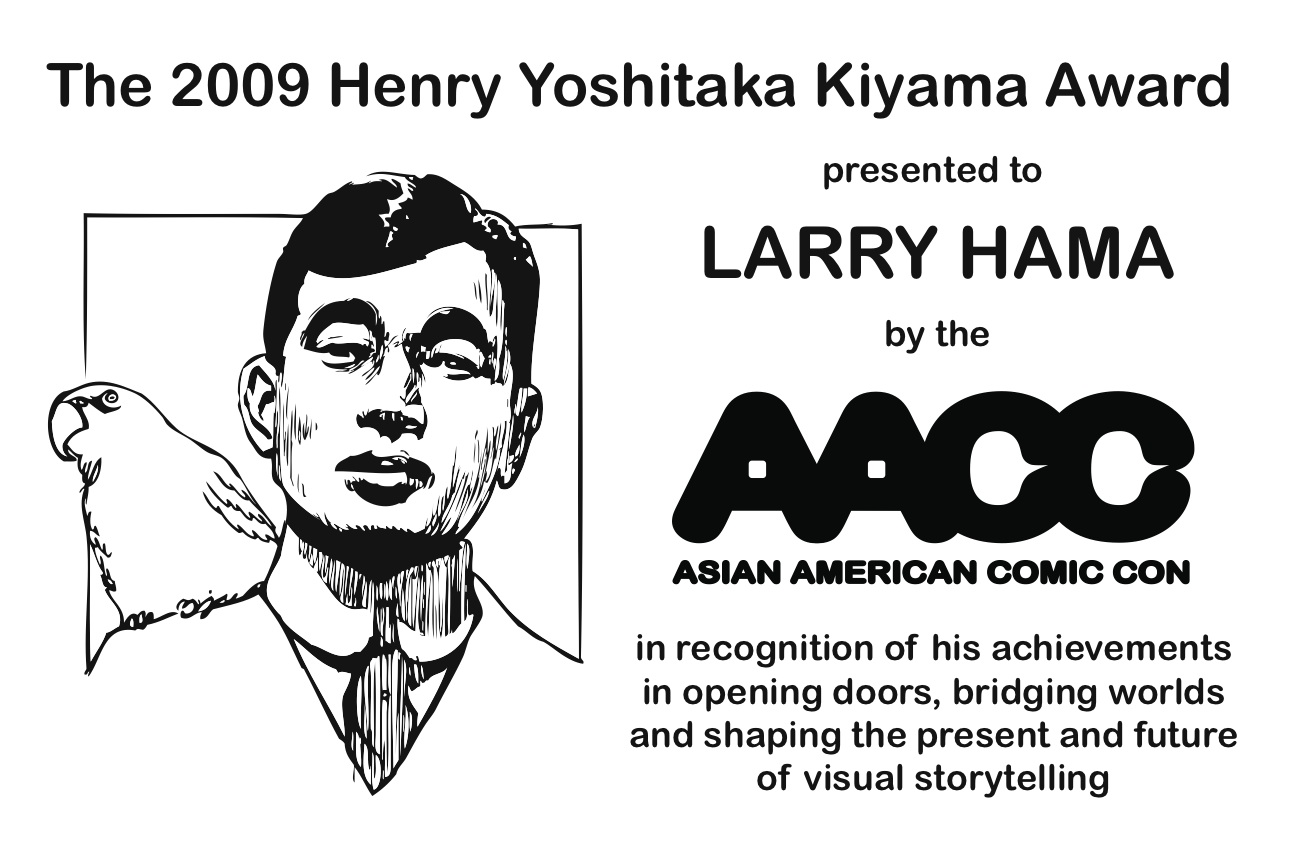
I nearly forgot about this upcoming event until I saw Larry Hama mention it on Facebook. He didn't mention that he was winning the Kiyama award, though. Congratulations, Larry! I first learned of the event at MoCCA Art Fest '09, when Charles Hatfield I had a great conversation with (and bought cool comics from!) Ken Wong. Ken's only one of the many cartoonists with stories in Secret Identities: The Asian American Superhero Anthology.

Here's some information about the Con, which looks to have a very interesting, widely varied line-up of panels. But for full info, be sure to visit the Asian American ComiCon website.


Asian American ComiCon
The Museum of Chinese in America
215 Centre Street, New York, NY
July 11, 2009, 10 am to 5pm

As artists, editors, writers and fans, Asian Americans have been a key creative force behind the graphical storytelling movement.

That's why some of the industry's leading Asian American creators have collaborated to organize this celebration of the unique contemporary role and historical legacy of Asians in the world of comics and cartoon art.

The event will bring together top artists, writers, fans and readers of mainstream and alternative graphic fiction with the larger Asian American community for a one-of-a-kind gathering, incorporating education, dialogue, spontaneous creativity, intergenerational outreach and the chance for established and emerging talent to show off their work.
WHY THE KIYAMA AWARD?
The organizers of AACC want this annual award to recognize the contribution of Asian and Asian Americans to U.S. comic book culture. No one better exemplifies that contribution than Henry Yoshitaka Kiyama, whose career represented the convergence of two worlds and industries, and whose work pointed the way to the future of graphic storytelling.

Kiyama published his breakthrough book The Four Immigrants in 1931. A poignant collection of cartoon stories about life as a Japanese student expatriate in the U.S. in San Francisco during the early part of the 20th century, it explores the issues these early immigrants faced in a world whose language, culture and traditions are new, strange and confusing.

Though the stories were originally intended for newspaper serialization, Kiyama never published them in that form, ultimately releasing them as a single book-length collection. This publication format, along with the fact that the stories in Four Immigrants featured a group of semiautobiographical characters (based on Kiyama and his friends) who grew, evolved and contended with real historical issues and events, has led some to advocate that it be recognized as the first original graphic novel published in America (arriving a decade before Virginia Lee Burton's 1941 Calico the Wonder Horse and nearly two decades before Arnold Drake, [Matt Baker,] and Leslie Waller's 1950 It Rhymes With Lust.

Labels: , , , , , ,